Increasing Frequency of Disaster Weather Events due to Climate Change

With all the floods in NSW I’ve been trying to locate a document I read several years ago about the frequency of natural disasters and climate change. I just found it! it’s the Climate Change Risks to Australia’s Coast report from 2009 by Department of Climate Change.

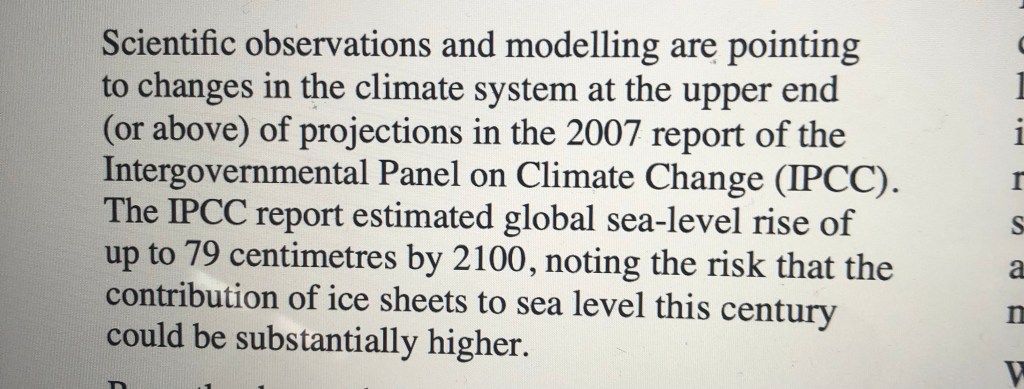
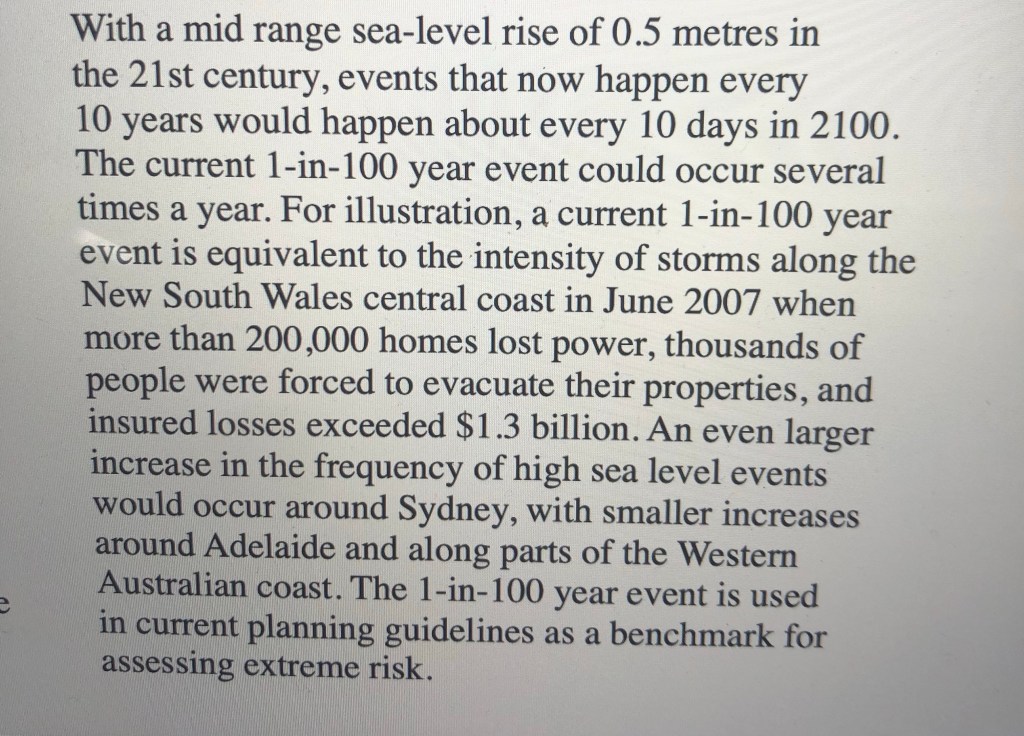
It says that disasters that happened every 1 in 10 years in the old normal, could happen every 1 in 10 days by 2100. Sea Level Rise is forecast to be 79cm by 2100 and will cause changes to weather events. Disasters that happened only every 1 in 100 years in the old normal, could happen several times in a single year by 2100.

Sea Level Rise since 1993 has been about 9cm. Over the last 100 years Sea Level Rise has been about 20cm.

Sea Level Rise takes a long time, due to the slow processes involved.

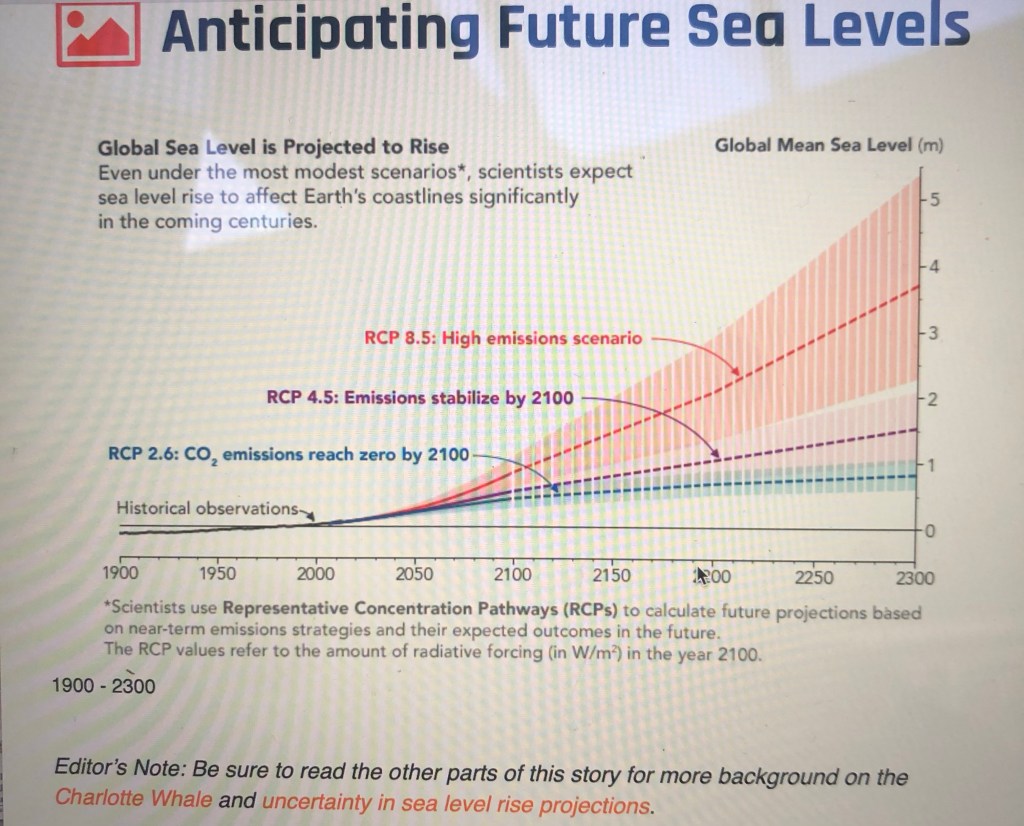
A good emissions reduction plan could see Sea Level Rise stabilise at just under a metre by 2300.

The worst outcome if we don’t reduce greenhouse emissions soon, would be around 4 to 5 metres of Sea Level Rise by 2300.

From a NASA document, this is what kind of possible Sea Level Rise scenarios we are looking at into the future:

Source: NASA Earth Observatory

NDIS Costs at Senate Estimates — 31 May 2012

I have found an interesting Hansard transcript from Senate Estimates where Senators from Labor, the Liberals, the Nationals, and the Greens were made aware of the NDIS costs issue by the Australian Government Actuary. Peter Martin from the Australian Government Actuary very clearly told them here that the 2011 estimate of NDIS costs by the Productivity Commission was not in future dollars. And Dr Ralph Lattimore (Assistant Commissioner from the Productivity Commission) also made it clear to the Senators that the 2011 estimates were not in future dollars. 

This was a 2012 Budget Estimates hearing for the Economics Legislation Committee held on Thursday 31 May 2012. 

Present were Committee Senators George Brandis (Liberal); David Bushby (Liberal); Doug Cameron (Labor); Richard Colbeck (Liberal); Mathias Cormann (Liberal); Mitch Fifield (Liberal); Barnaby Joyce (Nationals); Anne McEwen (Labor); Nick Sherry (Labor); Arthur Sinodinos (Liberal); Larissa Waters (Greens). From the Treasury Portfolio Senators Don Farrell (Labor) and Penny Wong (Labor) were present. The Secretary from the Department of the Treasury, Dr Martin Parkinson, was also present. 

At 14.58 the Committee questions the Actuary. Immediately before this Senator Wong absents herself from the session for 1 hour. Penny Wong: “While they are changing over, I am going to be replaced for a short period—about an hour—by Senator Farrell.”

Liberal Senator Mitch Fifield questions Peter Martin from the Australian Government Actuary. 

Fifield asks if the Actuary was commissioned to review the costings of the Productivity Commission on behalf of the COAG Select Council on Disability Reform, and Martin says “We were asked by the Treasury to review the reasonableness of the cost estimates undertaken by the PC.” “The work we did was in consultation with states and territories, so there was that COAG overlay to it.”

Martin says the Actuary’s work reviewing the NDIS costs “commenced on the second half of 2011”. 

Martin said the Actuary looked at the Productivity Commission’s methodology and assumptions to assess the reasonableness of what they had done, and then “we looked at trying to roll out those costs into future dollars. The Productivity Commission recommended full rollout in 2018-19. Their costings had not contemplated the inflationary effects between now and then.”

Senator Fifield and the Actuary spoke about the assumptions about NDIS participant numbers and how around 300,000 people had disability supports at that time, the Productivity Commission estimated around 411,000 people would be NDIS participants, contrasted to the 700,000 Australians who then had severe or profound level disability. Martin later says the Actuary did not look at what the NDIS would cost if it had 700,000 participants, responding to a question by Senator Fifield. 

Senator Fifield raised the issue of inflation and also the Fair Work SCHADS Decision: “ou said that you had to update some of the PC’s work for inflation. Another factor would be the Fair Work Australia decision in relation to sector workers pay.”

Martin makes a very important and relevant point about the cost estimates for the NDIS being the best they can do, but that it is hard estimating for a program which is completely different to how disability supports have traditionally been provided in Australia:

“The point that we have been trying to emphasise is that there is a lot of uncertainty around this number. We are talking about a National Disability Insurance Scheme, which is very different from the way disability services have been provided to date. In other words, if someone is eligible for support by virtue of their disability then they will be supported. So, you can only estimate the costs. It is not like, ‘Here is the budget, spend it and when you have run out that is it.’ More than that, the decisions around spending are in large part going to be subjective, qualitative decisions about what an individual’s needs are. We have been trying to emphasise that the cost estimates are the best available, but they are estimates.”

Senator Fifield asks “Would it be possible for a copy of the report which was provided to Treasury to be tabled for this committee?” and Martin says “We will take it on notice. Yes, it should be fine; it is with the states and territories. We will take it on notice.”

I presume that this is the 2012 Actuary’s report which states the NDIS will cost $22 billion at full scheme, expects full scheme to be arrived at in 2018-19, and says the average cost per participant will be $50,000. 

Senator Fifield says it would be useful to have the Actuary’s work in the public domain. 

Later in the hearing the NDIS comes up again, when the Productivity Commission is being questioned. 

Liberal Senator David Bushby handles the questioning this time. 

Dr Ralph Lattimore from the Productivity Commission clearly answers questions of the 2011 NDIS cost estimates, again explaining they were not in future dollars. 

” Our proposal is $2.4 billion in 2015-16. I should clarify the nature of our projections. Ours are real expenditures, so they are based on fixed constant price terms. They are not budget forecasts per se. In a budget forecast you would have to include price increases. But our model is one of constant prices.”

Senator Bushby asked “So the number in 2015-16 dollars would probably be a higher actual cost?”

And Dr Lattimore states plainly “It would be higher because inflation would push it up.”

Senator Penny Wong praises the Productivity Commission report and rebuts Liberal criticism of the early spending by Labor on the NDIS (the Liberals complained in 2012 and 2013 that Labor was not spending enough setting up the NDIS) “Let us just be clear. It is a very, very good report. The government has made a decision in a very tight budget to find $1 billion to commence the launch a year early and to do the learning in conjunction with the states from the implementation of those launch sites.”

Senator Bushby says the NDIS has bipartisan support, and Senator Wong says the Liberals don’t really support it and are asking all these Senate Estimates questions on the costs due to that:

“No, there is not. I get irritated on this issue where I would actually like bipartisanship. When the shadow Treasurer makes the comments he has made about not being able to support something because he cannot fund it, you come in here and are clearly running a political line of argument to the Productivity Commission. I would quite like it if we could actually say, ‘Let’s do this properly.’ We, this government, in a budget where we had to find $34 billion worth of savings, found $1 billion and brought a launch forward early because we think this is something very important.”

Senator Bushby complains that the Productivity Commission recommended one way of rolling out the NDIS and Labor have “proposed something different. I am just trying to juxtapose it to understand what that means in terms of your proposal and how it will be rolled out compared to what was recommended.”

Senator Bushby suggests a bipartisan committee for the NDIS, and Senator Wong hates the idea and says “To talk about it more? That is a good idea. Bipartisanship is not a committee. It is actually not playing politics with something. That is bipartisanship.”

The questioning then ends on very cross terms. 

Senator Bushby: We will leave it at that.

Senator Wong: Good idea.

Source: 

Hansard — Commonwealth of Australia

Australia, H. C. o. (2012). Effects of the GFC on the Australian Banking Sector: 10/08/2012: Senate: Economics References Committee. Hansard — Commonwealth of Australia Retrieved from https://parlinfo.aph.gov.au/parlInfo/download/committees/commsen/6d1c34b3-011e-45da-924e-97a7dec70169/toc_pdf/Economics%20References%20Committee_2012_08_10_1277_Official.pdf;fileType=application%2Fpdf#search=%22committees/commsen/6d1c34b3-011e-45da-924e-97a7dec70169/0006%22

Reference List for NDIS Costs

AAP (2)

AAP. (2012). Disability insurance scheme ‘to blow out’ 9News. Retrieved 25/06/2022 from https://www.9news.com.au/national/disability-insurance-scheme-to-blow-out/d1c375d9-83e3-47bd-b8f6-e14d0acffc4d

AAP. (2013). Gillard tight lipped on disability levy. Retrieved 25/06/2022, from https://www.9news.com.au/national/gillard-tight-lipped-on-disability-levy/28c2c282-13e9-4793-b359-7f22a86852a4 

ABC News (Australian Broadcasting Corporation) (2)

ABC News (Australian Broadcasting Corporation). (2012). Fair Work orders pay rise for community sector Retrieved 25/06/2022, from https://www.abc.net.au/news/2012-02-01/fair-work-orders-pay-increase-for-community-sector/3804682?nw=0

ABC News (Australian Broadcasting Corporation). (2012 ). Gillard Introduces NDIS Legislation (29/11/2012). Retrieved 25/06/2022, from https://www.abc.net.au/news/2012-11-29/gillard-introduces-ndis-legislation/4398358?nw=0&r=Interactive 

Arthur, Don (1)

Klapdor, M., & Arthur, D. (2017 (?)). Welfare — What Does It Cost? https://www.aph.gov.au/About_Parliament/Parliamentary_Departments/Parliamentary_Library/pubs/BriefingBook45p/WelfareCost

Australian Government Actuary (1)

Australian Government Actuary, (2012). NDIS Costings: A Review by the Australian Government Actuary (14/08/2012). Treasury (FOI Document) Retrieved from https://treasury.gov.au/sites/default/files/2019-03/doc1.pdf

Baker, Andrew (1)

Baker, A. (2012). The New Leviathan: A National Disability Insurance Scheme. Centre for Independent Studies. https://www.cis.org.au/wp-content/uploads/2015/07/pm131.pdf

Buckmaster, Luke (1)

Buckmaster, L., & Tomaras, J. (2013). NDIS Bill 2012 — APH Bills Digest. Bills Digest (Parliament of Australia), 72. https://parlinfo.aph.gov.au/parlInfo/download/legislation/billsdgs/2221959/upload_binary/2221959.pdf;fileType=application/pdf 

Burton, Tom (1)

Burton, T. (2021). Redesigning the complex disability services system. Australian Financial Review. https://www.afr.com/politics/federal/redesigning-the-complex-disability-services-system-20210113-p56tq4

Disability Intermediaries Australia (1)

Disability Intermediaries Australia.. (2021). Deep Dive Into NDIS Sustainability. Retrieved 25/06/2022 from https://www.intermediaries.org.au/news/deep-dive-into-ndis-sustainability/

Every Australian Counts (1)

Every Australian Counts. Journey so far – Every Australian Counts. Retrieved 25/06/2022 from https://everyaustraliancounts.com.au/about/journey-so-far/

Fletcher, Paul (1)

Fletcher, P. (2013). NDIS Bill 2012 Second Reading Speech 07/02/2013. Hansard APH HOUSE OF REPRESENTATIVES BILLS Retrieved from https://parlinfo.aph.gov.au/parlInfo/genpdf/chamber/hansardr/624d0842-94f0-49a5-b301-f2d86f83d947/0048/hansard_frag.pdf;fileType=application%2Fpdf

Grattan, Michelle (1)

Grattan, M. (2013). Medicare levy boost to pay for disability insurance scheme. The Conversation. Retrieved 25/06/2022, from https://theconversation.com/medicare-levy-boost-to-pay-for-disability-insurance-scheme-13861 

Hansard — Commonwealth of Australia (2)

Hansard — Commonwealth of Australia. (2012). Senate Estimates: Economic Legislation Commitee 31/05/2012. Hansard — Commonwealth of Australia Retrieved from https://parlinfo.aph.gov.au/parlInfo/download/committees/estimate/f8e0711d-2f08-466e-bb1d-80a0b801739c/toc_pdf/Economics%20Legislation%20Committee_2012_05_31_1084_Official.pdf;fileType=application%2Fpdf#search=%22committees/estimate/f8e0711d-2f08-466e-bb1d-80a0b801739c/0002%22

Australia, H. C. o. (2012). Effects of the GFC on the Australian Banking Sector: 10/08/2012: Senate: Economics References Committee. Hansard — Commonwealth of Australia Retrieved from https://parlinfo.aph.gov.au/parlInfo/download/committees/commsen/6d1c34b3-011e-45da-924e-97a7dec70169/toc_pdf/Economics%20References%20Committee_2012_08_10_1277_Official.pdf;fileType=application%2Fpdf#search=%22committees/commsen/6d1c34b3-011e-45da-924e-97a7dec70169/0006%22

Harrison, Dan (1)

Harrison, D. (2013, 15/05/2013). Disability scheme to be bigger than first estimated. The Sydney Morning Herald. https://www.smh.com.au/national/disability-scheme-to-be-bigger-than-first-estimated-20130514-2jl2b.html

Husic, Ed (1)

Husic, E. (2013). NDIS Bill 2012 Second Reading Speech 07/02/2013. Hansard APH HOUSE OF REPRESENTATIVES BILLS Retrieved from https://parlinfo.aph.gov.au/parlInfo/genpdf/chamber/hansardr/624d0842-94f0-49a5-b301-f2d86f83d947/0049/hansard_frag.pdf;fileType=application%2Fpdf

Ireland, Judith (1)

Ireland, J. (2013, 15/05/2013). Gillard chokes back tears on NDIS. The Sydney Morning Herald. https://www.smh.com.au/politics/federal/gillard-chokes-back-tears-on-ndis-20130515-2jlla.html

Johnson, Sarah (NDIS Actuary) (1)

Johnson, S. N. A. (2021). NDIS Annual Financial Sustainability Report.  Retrieved from https://www.ndis.gov.au/media/3579/download?attachment

Karp, Paul (1)

Karp, P. (2017, 09/05/2017). Federal budget: Medicare levy and taxes to fully fund National Disability Insurance Scheme | Australian budget 2017 |. The Guardian. https://www.theguardian.com/australia-news/2017/may/09/australia-federal-budget-2017-national-disability-insurance-scheme-funded-medicare-levy

Klapdor, Michael (1)

Klapdor, M., & Arthur, D. (2017 (?)). Welfare — What Does It Cost? https://www.aph.gov.au/About_Parliament/Parliamentary_Departments/Parliamentary_Library/pubs/BriefingBook45p/WelfareCost 

Murphy, Katherine (1)

Murphy, K. (2017, 22/05/2017). Turnbull goads Shorten over Labor split on 0.5% Medicare levy for NDIS. The Guardian. https://www.theguardian.com/australia-news/2017/may/22/malcolm-turnbull-prods-labor-into-backing-05-medicare-levy-for-ndis

news.com.au Staff Writer (1)

Staff Writer. (2013). Medicare levy hike for NDIS to be law after it passes Parliament. Retrieved 25/06/2022, from https://www.news.com.au/national/medicare-levy-hike-for-ndis-to-be-law-after-it-passes-parliament/news-story/f9c93f840c423f4567c5fea4d4e0dfc7 

Parliament of Australia (2)

Parliament of Australia. (2013). Second Reading Speeches NDIS Bill 2o13 – Page 2. Retrieved 25/06/2022 from https://www.aph.gov.au/Parliamentary%20Business/Bills%20Legislation/Bills%20Search%20Results/Result/Second%20Reading%20Speeches?BillId=r4946&Take=100&Page=2

Parliament of Australia. (2013). Second Reading Speeches NDIS Bill 2013 – Page 1 Retrieved 25/06/2022 from https://www.aph.gov.au/Parliamentary%20Business/Bills%20Legislation/Bills%20Search%20Results/Result/Second%20Reading%20Speeches?BillId=r4946&Take=100&Page=1

The Productivity Commission (3)

The Productivity Commission. (2011). Disability Care And Support Vol 1: Productivity Commission Inquiry Report. https://www.pc.gov.au/inquiries/completed/disability-support/report/disability-support-volume1.pdf

The Productivity Commission. (2011). Disability Care and Support Vol 2: Productivity Commission Inquiry Report https://www.pc.gov.au/inquiries/completed/disability-support/report/disability-support-volume2.pdf

The Productivity Commission. (2017). National Disability Insurance Scheme (NDIS) Costs: Productivity Commission Study Report. https://www.pc.gov.au/inquiries/completed/ndis-costs/report/ndis-costs.pdf

PwC Thought Leadership Group, Chris Bennett (Partner, Government Sector Leader) (1)

PwC Thought Leadership Group, Bennett, Chris (Partner, Government Sector Leader). (2011). Disability Expectations: Investing In A Better Life, A Stronger Australia. PwC. https://www.pwc.com.au/industry/government/assets/disability-in-australia.pdf

Russel Kennedy Lawyers (1)

Russell Kennedy Lawyers. (2012). Equal Remuneration Decision 03/02/2012. Retrieved 25/06/2022 from https://www.russellkennedy.com.au/insights-events/insights/equal-remuneration-decision

Sammut, Jeremy (1)

Sammut, J. (2017). Fiscal Fiction: The Real Medicare Levy. Centre for Independent Studies. https://www.cis.org.au/wp-content/uploads/2017/05/rr27.pdf

Tomaras, Juli (1)

Buckmaster, L., & Tomaras, J. (2013). NDIS Bill 2012 — APH Bills Digest. Bills Digest (Parliament of Australia), 72. https://parlinfo.aph.gov.au/parlInfo/download/legislation/billsdgs/2221959/upload_binary/2221959.pdf;fileType=application/pdf 

The Treasury — Commonwealth of Australia (1)

The Treasury — Commonwealth of Australia. (2013). The Budget 2013: DisabilityCare Australia.  Retrieved from https://archive.budget.gov.au/2013-14/glossy/glossy_NDIS.pdf

Wikipedia (1)

Wikipedia. Australia 2020 Summit – Wikipedia. Wikipedia. https://en.m.wikipedia.org/wiki/Australia_2020_Summit

Wilkie, Andrew (1)

Wilkie, A. (2013). NDIS Bill 2012 Second Reading Speech 11/02/2013. Hansard APH HOUSE OF REPRESENTATIVES BILLS Retrieved from https://parlinfo.aph.gov.au/parlInfo/genpdf/chamber/hansardr/31814f37-6bd0-44dd-a2e7-40d55027d5cf/0196/hansard_frag.pdf;fileType=application%2Fpdf

NDIS Costs Report (Draft June 2022)

This is a draft report based on my research into NDIS Costs over the last 2 years. I would ultimately like to get this published in the media as there are so many factual inaccuracies about the NDIS and NDIS costs being published by journalists who are not across the detail of this complex system.

I am an NDIS participant myself since 2017 when the NDIS rolled out in Castlemaine, Victoria. I have Psychosocial Disability, and developed Schizoaffective Disorder in 2006 when I was 27, and from 2013 to 2018 had Delusional Disorder. In 2019 I got a late diagnosis of Autism Spectrum Disorder Level 2. I have above average verbal IQ so my disabilities do not impact on my ability to research NDIS costs.

I began to research NDIS costs in 2020 after the NDIA and the Minister started saying the NDIS was unsustainable and that they would make us have the Independent Assessments. I was actively part of the campaign against the Independent Assessments in 2020 and 2021.  

In my research I found some big problems with the NDIS costs, including wage inflation from the February 2012 Fair Work SCHADS decision, and the Parliament being given an outdated and significantly lower cost estimate by the Gillard Labor Government while the NDIS Bill was being debated in early 2013. 

I have a BA in history from ACU and got half way though a MA in Urban Planning at Melbourne University before my mental illness got too bad for me to study anymore. My MA coursework included an economics subject and multiple policy subjects. 

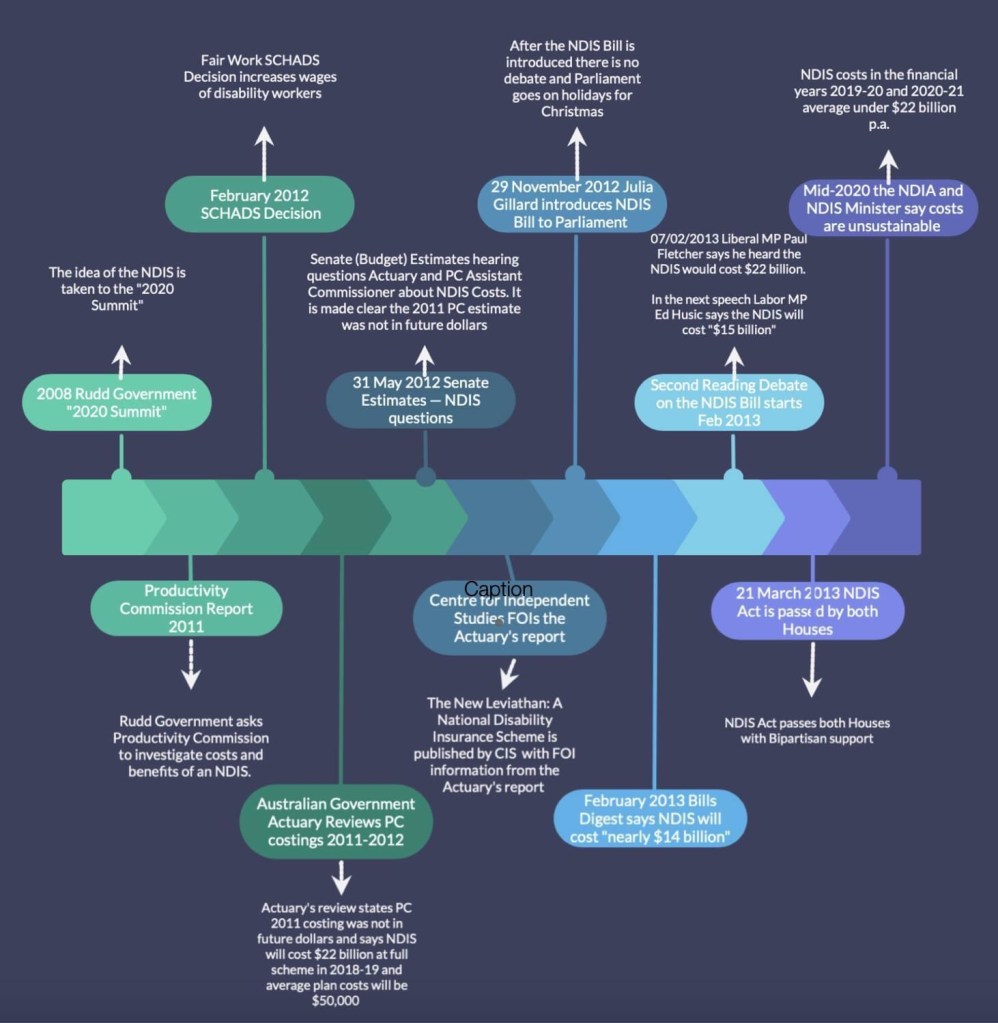
After the idea of an NDIS was raised at the Rudd Government’s April 2008 “2020 Summit” Labor got the Productivity Commission to do a cost benefit analysis of an NDIS. 

History of NDIS Cost Estimates 2011-2012

The Productivity Commission handed the report to the Gillard Labor Government in 2011. 

The Productivity Commission cost estimate for the NDIS at “full scheme” was $13.6 billion.

“Full scheme” is the term used to describe the time when the NDIS became fully rolled out nationally. The NDIS began the transition to full scheme in 2017, after a trial period from 2013-2017. In mid-2020 the NDIS entered full scheme. 

The 2011 Productivity Commission Report figure of $13.6 billion was in 2011 dollars, i.e. what the NDIS would cost if it was implemented fully in 2011. It did not take inflation into account at all.

Prior to the NDIS the Federal, State, and Territory Governments funded disability services at $7.1 billion a year. So the figure of $13.6 billion was almost double the existing funding for disability services, or an additional $6.5 billion. 

Price Waterhouse Cooper also published a report on the NDIS in 2011. This report is quite bizarre as it has a graph of the NDIS costing $15 billion a year long into the future. That was not what the Productivity Commission 2011 Report said, and the Price Waterhouse Cooper report provides no justification for these figures. I have been unable to find more information on this.

In February 2012 the Fair Work Commission handed down an important decision on the SCHADS Award. This was reported widely and was publicly celebrated by PM Julia Gillard. The Labor Government was therefore aware of it. 

The SCHADS Decision stated that under the Fair Work Act 2009 workers in non-government organisations were entitled to the same wages as workers in the government sector doing the same job. The NDIS was heavily exposed to the SCHADS Decision because disability services were provided by both the government and the non-government sectors. As the NDIS was rolled out nationally the proportion serviced by the non-government sector would increase as the NDIS is a market based program. 

The SCHADS wage rises included a 19% raise for Level 2 workers and 41% raise for Level 8 workers. The SCHADS wage rises were to be implemented over several years. 

Following the Fair Work SCHADS Decision in 2012 the Treasury asked the Australian Government Actuary to update the cost estimate of the NDIS. 

This cost estimate was $22 billion at full scheme and included the SCHADS decision and other wage inflation. It expected the NDIS to enter full scheme in 2018-2019. 

This estimate of $22 billion was $8.4 billion more than the 2011 estimate of $13.6 billion for the NDIS, and it was $14.9 billion more than the $7.1 billion that had been spend on disability supports prior to the NDIS. 

The Productivity Commission 2017 Report on NDIS Costs broke down the 2012 $22 billion figure, saying that $6.38 billion was due to the Fair Work SCHADS Decision and other wage inflation, while additional non-wage factors were responsible for the other $2.02 billion in increased costs.

There is no information I can find saying how much of the $6.38 billion was due specifically to the SCHADS Decision, and how much was due to other normal wage inflation, but ordinary wage inflation from 2013 to 2020 was not that high.

The updated estimate of $22 billion was obtained via FOI by the Centre for Independent Studies in 2012 and the figure was published in a 2012 work by Andrew Baker, now of DSS, called The New Leviathan: A National Disability Insurance Scheme. 

On 14th of November 2012 9News did an online citing the $22 billion figure obtained by the Centre for Independent Studies ‘Disability insurance scheme to “blow out”’. 

“A Centre for Independent Studies report says the scheme will become “the new leviathan of the Australian welfare state”. It cites a secret review by the Australian Government Actuary (AGA) released under freedom of information that revealed the NDIS will provide disability care to 441,000 people at a cost of $22 billion a year or $50,000 per person when it is fully operational in 2018-19.”

The full 2012 report by the Actuary is available on the Treasury website.  

The NDIS did not end up entering full scheme in financial year 2018-2019 it entered full scheme in mid-2020 which is between two financial years. The average of the two financial years 2019-2020 and 2020-2021 is just under $22 billion per year. 

So the Actuary was really accurate in their 2012 updating of the NDIS cost estimate, and the NDIS was on track with this estimate.

In 2017 the PBO estimated the NDIS would cost $24.0 billion in 2019-2020, so the NDIS actually came in under that estimate. (See “Welfare—What Does It Cost” on APH website).

There are quite a lot of cost estimates made from 2011 onwards, and the media unfortunately are not across all the different cost estimates that have been made.

NDIS Bill Parliamentary Debate 2012-2013

The Gillard Labor Government did not give Parliament the 2012 updated NDIS cost of $22 billion, instead they gave Parliament the 2011 cost that did not take into consideration the SCHADS Decision or any inflation. 

I am shocked and disappointed that the Gillard Government gave Parliament the wrong and outdated cost estimate, and that Parliament did not actually debate the costs properly. The entire debate on the NDIS Bill went for less than 2 months, from February 2013 to 21st of March 2013 when the NDIS Act passed both Houses of Parliament. There were only three mentions of the cost of the NDIS at full scheme in the entire debate. I believe this was a rushed and not thorough debate, that did a disservice to severely disabled Australians.

On 29th of November 2012 Julia Gillard introduced the NDIS Bill to Parliament, but there was no debate as the Parliament went on holidays for Christmas. 

After Christmas holidays the Parliament began to debate the NDIS Bill in February 2013. 

In the February 2013 Bills Digest by Luke Buckmaster it states the NDIS will cost “nearly $14 billion” using the outdated 2011 estimate.

“The Commission estimated that the NDIS would cost an additional $6.5 billion annually. When added to current annual expenditure on disability services of $7.1 billion, this would amount to an increase in funding of around 90%” p. 8

“As noted in the Parliamentary Library’s Budget Review 2012-2013: …. ’The estimated annual cost (nearly $14 billion) is around the same amount spent on the disability support pension…’” p. 18

This does not make clear that the cost “nearly $14 billion” is from the outdated 2011 estimate made in 2011 dollars, and does not mention the 2012 updated estimate of $22 billion. 

In the Debate no Cabinet Ministers spoke other than Prime Minister Gillard herself and the relevant Minister, Jenny Macklin. 

Only 3 politicians mentioned the cost of the NDIS at full scheme: LNP MP Paul Fletcher, ALP MP Ed Husic, and Independent Andrew Wilkie. 

On 7th of February 2013 Paul Fletcher cited the $22 billion figure by the Australian Government Actuary:

“According to a report issued by the Centre for Independent Studies, drawing on a review conducted by the Australian Government Actuary, which was obtained under freedom of information legislation, the cost of the NDIS by the projected first year of operation, 2018-19, is likely to be around $22 billion a year—substantially greater than the $15 billion figure usually quoted—and the costs are likely to rise each year.”

Ed Husic, also spoke on 7th of February 2013 following Fletcher, and he immediately rebutted Fletcher by claiming the NDIS would cost “$15 billion”:

“This is not going to come cheaply. It will require a major contribution. Providing the level of support needed to ensure we liberate people from the anxiety of long-term care has a potential cost of $15 billion a year. In time, I think we will need to think laterally about the way we fund the NDIS.”

Andrew Wilkie simply stated that it didn’t matter what the NDIS would cost.

I think this is fiscally irresponsible and also not fair to disabled NDIS participants who have now spent almost 2 years in turmoil because of claims the NDIS is not financially sustainable. And this is during a global pandemic when we are already stressed and at risk of dying ourselves, or losing our elderly parents who support us to COVID-19. 

The NDIS Bill was passed by both Houses of Parliament on 21 March 2013. 

In the May Budget 2013 Labor admitted the cost estimate of the NDIS was $22 billion.

Medicare Levy and Funding the NDIS (Edited 26/06/2022)

In April 2013 the media reported on speculation that Labor was planning on funding the NDIS via an increase to the Medicare Levy. 

‘Prime Minister Julia Gillard is refusing to engage in budget speculation including suggestions an increase in the Medicare levy could be used to fund the national disability insurance scheme. “I’m simply not playing the game,” she told ABC radio on Wednesday.’ — SBS 24/04/2013

On 1 May 2013 Prime Minister Julia Gillard confirmed Labor would increase the Medicare Levy by 0.5% to pay for the NDIS.

Opposition Leader Tony Abbott agreed to support this, and on 15 May 2013 Labor introduced legislation for the 0.5% increase in the Medicare Levy to help raise funds for the NDIS with bipartisan support. The legislation was passed by both houses just “a day after a teary-eyed Prime Minister Julia Gillard introduced new bills increasing the Medicare Levy.”

This increased the Medicare Levy from 1.5% to 2%. Three-quarters of this revenue goes to Medicare and one-quarter to the NDIS. 

2013 was a year with a Labor leadership change, and a federal election. Kevin Rudd became Prime Minister for a second time in June 2013, and in September 2013 following the election the LNP took over as Government and Tony Abbott became Prime Minister. 

The increase to the Medicare Levy does not raise much funding compared to the increased costs of disability support funding following the introduction of the NDIS. 

In 2014-15 the Medicare + NDIS Levy raised $14.6 billion, with $10.75 billion going to Medicare, and only $3.85 billion going to the NDIS. These figures come from the Centre of Independent Studies work Fiscal Fiction: The Real Medicare Levy.

Disability support funding went from $7.1 billion in 2011 to $22 billion in 2020, to almost $30 billion in 2021-22. That is an increase of almost $23 billion — or a bit over a quadrupling of funding — in a single decade. 

In 2017-2018 the LNP, now led by Prime Minister Malcolm Turnbull, proposed another 0.5% increase to the Medicare Levy to raise more funds for the NDIS.

The Labor Opposition refused to support this, with Opposition Leader Bill Shorten saying that it was a tax on ordinary workers. Shorten wanted the Levy increase to only apply to the top two tax brackers, whereas the Coaliton Government wanted it to apply to everyone earning over $21,000 p.a.

There have been no additional taxes or levies to raise funds for the NDIS since the first 0.5% increase to the Medicare Levy. 

The Morrison Government said the NDIS would be funded under consolidated revenue.

However the Australian Federal Government Budget has been in deficit every year since 2011-2012 and consolidated revenue is not able to cover all the costs of Government spending. 

NDIS Costs as a % of GDP

The costs of disabiliity supports is growing as a percentage of GDP. 

It was 0.47% prior to NDIS and is expected to be around 2.3% by 2030.

Australian GDP was about $1.5 trillion in 2011-2012 according to ABS. 2011 Disability Supports cost around $7.1 billion which was about 0.47% of GDP. The Productivity Commission 2011 estimate for the NDIS cost of $13.6 billion was about 0.9% of GDP.

GDP was $1.9 trillion according to ABS in 2019-2020.  $22 billion cost of the NDIS in 2020  was about 1.2% of GDP. 

GDP is expected to be $2.058 trillion in 2021-2022 according to APH, and the NDIS is expected to cost just under $30 billion which is 1.457% of GDP. 

GDP is expected to be $2.6 trillion in 2030, as Treasury estimates a growth rate of 2.6% per year. In 2030 the NDIA Actuary estimates the NDIS will cost $60 billion, this would be 2.3% of GDP. 

So Disability Supports have gone from 0.47% of GDP to 1.457% of GDP in around a decade, and are exopected to reach 2.3% of GDP in 8 years.  

Australia currently has a tax to GDP ratio of 28%. 

Federal revenue is 23% of GDP (about $500 billion), and States and Territories combined collect another 5% of GDP ($100 billion) as revenue. 

The coalition had an election platform of Federal revenue collection not exceeding 23% of GDP. Labor has not announced any new taxation revenue collection. The Greens have announced a policy to collect more tax via taxing billionaires. 

As a comparison, Finland has a tax to GDP ratio of 43%. 

In the current economy every 5% equals around $100 billion, so if our tax to GDP ratio was lifted by 15% to be 43% like Finland’s it would bring in $300 billion more per year in revenue.

For a decade Australia has been running Budget deficits because our spending exceeds our revenue, and the population does not want the Government to cut back on spending in popular programs. If anything the population wants more spending on programs such as aged care, mental health, child care, and climate change. 

Roughly a third of all taxes in Australia go to healthcare ($202 billion per year), and a sixth go to education ($100 billion), so of our total taxation revenue 50% is taken up by healthcare and education.

This leaves only 50% of revenue (or $300 billion) for everything else, including the NDIS, Centrelink, My Aged Care, Child Care, Defence, Infrastructure, Housing, Foreign Affairs, the Environment and Climate Change. 

Australia has not followed the recommendations of the 2010 Henry Tax Review, and we have an outdated tax system that is not fit for purpose. 

The selfish “Big Miners” attacked Kevin Rudd when he tried to implement the Henry Tax Review’s recommendation for a Mining Resources Tax. This led to political destabilisation of our Federal Government and no Government since then has dared to stand up to these selfish interests and implement much needed tax reform.

NDIS Costs to 2030

In the 2022 election campaign Labor talked about reducing costs by cutting down on lawyers at the AAT but lawyers only cost $28 million over 6 months, which is a tiny fraction (0.09%) of what the NDIS costs per year currenlty. Cutting all of the lawyers would barely make a dint in the cost of the NDIS.

The main driver of the NDIS costs are the cost of participants’ supports. 

There are three factors to this:

  • the number of participants
  • the amount of participant supports granted in plans and utilised by participants
  • the wages, overheads, and profits charged by providers

The Actuary’s 2012 updated cost estimate said at full scheme (then expected to be in 2018-2019) the average cost per participant would be $50,000. 

In February 2021 the CEO Martin Hoffman told the Australian Financial Review that the average plan cost per participant was $52,000. 

That is only a $2000 difference, which is not a lot. 

Now the average cost per participant has gone up to $57,800, but the Actuary in 2012 didn’t give an estimate for the years after 2018-19. 

The average participant plan cost is a lot lower than the average participant plan funding, because utilisation rates are under 100%. 

In the latest figures I have, the average plan funding is $68,500 while the average plan cost is only $57,800 due to below 100% utilisation. 

Average plan funding grew rapidly between 2017 and 2020. 

The NDIS rapidly grew between 2017 and 2020, taking on new staff and contractors, as well as new participants. 2017 was the year that the NDIS entered the “Transition to Full Scheme” period, following the earlier trial sites period. This meant the NDIA and LACs had to take on new staff. 2018-2019 was the period where there was an NDIS “underspend” of billions of dollars due to there being fewer participants than estimated. Following this the NDIA made an effort to recruit more participants quickly.

In 2017-2018 average plan funding was $38,000.

In 2018-2019 average plan funding went up to $46,000.

In 2019-2020 average plan funding went up to $61,000.

In 2020 average plan funding was $71,000.

In 2021 average plan funding went slightly down to $68,500. 

In the period 2017-2019 the NDIA CEO was Rob de Luca, appointed by Minister Christian Porter.  De Luca had no experience in disability or in the government sector. He was previosly Managing Director of BankWest. If you look on the Australian Parliament House website Rob de Luca gets grilled by a Nationals Senator about BankWest and the GFC. The Nationals Senator implies that under Rob de Luca BankWest told valuers what to value property as, in a corrupt way. Rob de Luca left the NDIA and went into working for Zenitas Healthcare that then tried to get the Independent Assessment contracts, which many of us feel was unethical.

Martin Hoffman was appointed NDIA CEO in November 2019, Hoffman had prior experience in the government sector, but became CEO when the NDIS was only 7 months away from entering full scheme. Under de Luca the NDIA attempted to begin to manage costs escalating with Operation Greenlight which was set up around March 2018. This turned into the Independent Assessments proposal, which was resolutely rejected by most participants, including myself, as well as by experts and the sector.

By 2030 the NDIS is expected to cost about $60 billion per year.

The media has been concentrating on reporting about the financial unsustainability of the NDIS by focusing on the participant plan funding going up so much, but actually by 2030 the average participant plan spend is only estimated to be $68,905, compared to $57,800 now. That is only growth of $1400 per year on average. 

The main driver of the cost increases expected between now and 2030 is not the average plan spend going up, but the projected increase in participant numbers.

The Actuary estimates that a lot more participants especially those with a primary disability of Autism Spectrum Disorder, followed by Psychosocial Disability), and then Intellectual Disability will join the NDIS between now and 2030. 

The NDIA 2021 Sustainability Report estimated that by 2030 the total number of participants with Autism as a primary disability will be 339,035. 

The prevalence of Autism is estimated by WHO at 1 in 100, and in Australia in 2015 the prevalence of people diagnosed with Autism was 1 in 150, and Autism Spectrum Australia estimates that 1 in 70 Australians have autism.

If we take the 1 in 70 figure, that is 367,000. 

So the NDIA Actuary is assuming that almost every Australian with Autism will be an NDIS participant with a primary disability of Autism by 2030, or else they are assuming the prevalence of Autism is higher than 1 in 70. 

Some Autistic NDIS participants like me do not have Autism as our primary disability. My primary disability for the NDIS is Psychosocial Disability. Autism is listed as my Secondary Disability. The NDIS IT system makes us choose just one of our disabilities to be our “primary disability” if we have multiple disabilties.  

My cousin Jessica is a modeller for the Commonwealth Bank and she said she can’t really analyse these figures and how the different estimates relate, without access to the model and the data and the assumptions the Scheme Actuary is using. 

But the NDIA refuses to provide access to the models.

Jessica told me the Government gave the four big banks access to data so they could model Covid-19 scenarios in 2020. 

Why can’t this be done with the NDIS?

**** 

Problems with the NDIS Act 2013 

The problem of the higher than expected number of participants is caused by the NDIS Act 2013, which is unclear about who is eligible for the NDIS. 

The Productivity Commission stated the NDIS was for people with “severe” disability, but the NDIS Act states it is for “significant” disability. There is no explanation of what “significant” disability is and is not. 

The eligibility criteria in the Act is circular logic, saying someone is eligible for the NDIS if they have significant and permanent disability and they need NDIS supports. It is extremely circular to say someone is eligible for a program if they need it. 

The NDIS funding is uncapped so there is no cap on the number of participants. In other Government programs eligibility may be based on set criteria or else scarce funding create an eligibiliity cut off point.  

Another change in the NDIS Act from the 2011 Productivity Commission Report is the planning process.

The Productivity Commission design was for an internal NDIA planning process from start to finish, where participants met with one NDIA planner, and that planner interviewed us, read our reports and letters, and gave us a functional assessment. The Act only specifies that plans need to be done by a delegate of the CEO, and the NDIA farmed out most of the planning process to the Local Area Coordinator contractors after PM Abbott instigated staffing caps at the NDIA. 

Tier 2 of the NDIA is also not mentioned in the NDIS Act. The Productivity Commission design for the NDIS had 3 Tiers.

Tier 1 was the whole of Australia — everyone who knows the NDIS is there for them and their loved ones if they become disabled, and many of whom contribute to the costs of the NDIS via taxes.

Tier 2 was disabled people who were not eligible for the NDIS, and would have their needs met via help to access mainstream services and by Tier 2 encouraging communtiies and businesses to be more accessible and inclusive of people with disabilities. This was not for disability services. It was for making mainstream services accessible for disabled people and able to meet disabled people’s needs.

Tier 3 was for disabled people who were eligible for NDIS plan funding.

Tier 2 was completely left out of the NDIS Act and then forgotten.

Bruce Bonyhady and John Walsh both say that this was detrimental for the costs of the NDIS as well as for the wellbeing of disabled people not-eligible for the NDIS. 

Conclusion

These issues will now be difficult to address. 

It will be hard for any Government to introduce clearer eligibility criteria for the NDIS that could make some existing participants ineligible. 

Because of the botched Independent Assessment proposal it is going to be very difficult to convince participants and their families that the planning process should standardise functional assessments in any way. But the current planning process is completely inconsistent and varies from person to person as to whether someone gets a stingy plan or a generous plan. 

Tier 2 has support from the NDIS community, but there is general unhappiness when the NDIS tells people to use mainstream supports rather than get NDIS funding for the support. Especially because mainstream supports often do not exist, and if they do exist they may charge us something that we then have to find the money for, or else they may be low quality (for example the Disability Employment Services). 

One thing to remember is many NDIS participants only income is Centrelink. All Centrelink payments are below the poverty line. Many of us experience housing insecurity and can’t find appropriate public housing, and NDIS Specialist Disability Accommodation housing is only for a small number of participants, and we face social isolation due to our disabilities and low incomes. 

The interaction between NDIS and other Government programs and mainstream supports has not been well managed to date. 

This leaves many participants relying mainly on the NDIS for their quality of life. 

Average NDIS Plan Funding

2017 was the year that the NDIS entered the “Transition to Full Scheme” period, following the earlier trial sites period. This meant the NDIA and LACs had to take on new staff. 2018-2019 was the period where there was an NDIS “underspend” due to there being fewer participants than estimated. The money from the “underspend” went back into general government revenue. Following this the NDIA made an effort to recruit more participants quickly.

In 2017-2018 average plan funding was $38,000.

In 2018-2019 average plan funding went up to $46,000.

In 2019-2020 average plan funding went up to $61,000.

In 2020 average plan funding was $71,000.

In 2021 average plan funding went slightly down to $68,500.

NDIS Costs as a % of GDP

This is another one of my posts on NDIS Costs.

This week I have been looking at NDIS costs as a percentage of GDP.

Australia’s GDP was $1.5 trillion in 2011 (ABS) when the Productivity Commission reported on the NDIS, over the last decade has grown around 40%. This is a slower rate of growth than the previous decade in the Mining Boom years, when GDP grew around 53% over 10 years.

In 2011 the Federal and State/Territory combined spending on Disability Support was $7.1 billion, which was about 0.47% of GDP.

The Productivity Commission 2011 Report on the NDIS estimated it would cost $13.6 billion in 2011 dollars if it was fully rolled out that year. This was about 0.9% of GDP in that year.

The Australian Government Actuary updated the estimate for the NDIS in 2012, saying the NDIS would cost $22 billion at full scheme, which was expected to occur in 2018-2019.

NDIS entered full scheme in mid-2020 and the cost of the NDIS was roughly just under $22 billion per year, when averaged over two financial years.

GDP in 2019-2020 was $1.9 trillion (ABS), and the NDIS cost of $22 billion was about 1.2% of GDP.

This financial year 2021-22 GDP is expected to be $2.06 trillion (ABS), and the NDIS is expected to cost just under $30 billion which will be about 1.45% of GDP.

So we have seen Disability Supports go from 0.47% of GDP prior to the NDIS when it was widely acknowledged the system was underfunded and failing people, to around 1.45% of GDP this financial year.

The NDIA Actuary estimates the NDIS will cost $60 billion by 2030. GDP is expected to be $2.6 trillion in 2030, as Treasury estimates a growth rate of 2.6% per year. So the NDIS is expected to cost 2.3% of GDP in 2030.

The Federal Government collects around 23% of GDP as revenue. States and Territories combined collect another 5% of GDP, taking all taxation revenue in Australia to a ratio of around 28% of GDP. Total combined Federal and States/Territories government revenue in Australia is roughly $600 billion.

The Coalition has committed that if it stays on as Government Federal revenue collection will continue to be under 23% of GDP.

The Greens have a policy of raising the tax to GDP ratio by increasing taxes on billionaires.
I am not sure what Labor’s election policy on taxation is.

In the last decade there have been Budget deficits every single financial year, leading to growing debt. I personally feel like we should lift the tax to GDP ratio by 5% which would collect about $100 billion in revenue per year.

Canon to the Right of Them, Canon to the Left of Them: War in Ukraine

Russia began to wage war on Ukraine just over a month ago. This is the closest to nuclear war we have come in my lifetime. On social media it is depressing how many people appear to think risking nuclear war would be worth it for America to show Russia who is boss globally.

Of course this is not the first war in my life, it is only the first one where a potential enemy country with nuclear weapons has started a serious war. Russia has had wars before but smaller ones in Afghanistan and Chechnya.

America has also started wars in my lifetime, but as we consider them a friend it was not as worrying that a large power with nuclear weapons was going around starting wars in Afghanistan and Iraq.

Russia annexed the Crimean Peninsula from Ukraine in 2014.

The 19th Century Crimean War (1853-65) took place at a time when the power relations in Europe and the Middle East were changing, much as in today’s world. The Ottoman Empire was in decline and it’s territory was potentially spoils for other Empires and nations. The UK and France fought against Russia alongside the Ottoman Empire, only to agree to carve up the Ottoman Empire between themselves in the Sykes-Picot Agreement of 1916.

The Crimean War’s Charge of the Light Brigade was portrayed as a heroic failure much as Australia portrays the WW1 Gallipoli campaign. The medical conditions in the battlefields were so bad that Florence Nightingale determined to reform practices and sanitation.

It is almost a surprise that Russia has started a serious war on an American ally, as while international politics has become more fractious in the last 15 years, American attention has been on China, who it sees as it’s current biggest international rival. Obama in 2012 directed American foreign policy to “pivot to Asia”.

However it is not 100% a surprise because Russia was involved in the Syrian War, as well as the war in Chechnya and annexing the Crimean Peninsula, plus poisoning people seen as threats like Alexander Litvinenko and Sergei and Yulia Skripal.

It is impossible to know how long the war in Ukraine will go for. It seems certain Ukraine will not gain anything from the war other than perhaps managing to save its independence from Russia. Russia will lose a lot of money and lives and at best will gain a bit more territory, yet the only bit being useful to it is Crimea which has a port.

Russia states it doesn’t want NATO and NATO missiles so close to its borders, which on the surface seems reasonable because it’s similar to the position the USA had in regard to Cuba having Soviet missiles in the Cuban Missile Crisis. However it is difficult to know if this is really all Russia wants.

America and its allies in Europe look weakened from their inaction. While sanctions will economically affect Russia, and military aid will assist Ukraine, this war is showing that if a nuclear country wages war on a smaller non-nuclear country, America and its allies are unlikely to militarily assist the smaller non-nuclear country.

For Australia this is a relevant lesson when we think about our future Defence planning. Like Ukraine we are a small non-nuclear country. We rely on the idea that America would defend us militarily if it ever becomes necessary.

Now we have climate change, a pandemic, and Russia waging a war, and honestly I think this is the worst year in my whole life in terms of these exterior global things.

I try to take comfort in the pleasant things of every day life like picking quinces and enjoying the beautiful Autumn days, but doing so reminds me so much of the people in the Belle Époque who focused on all their lovely things as WW1 crept up on them. Let that not be us.

Choir Singing

One of my favourite things is singing in choirs. I have always loved music and as an autstic woman I am highly sensitive to sounds, both positive (music) and negative (traffic). This is a blessing and a curse.

I am a member of the local inclusive choir The Peace Choir which is funded by some philanthropists. The choir leaders are well known singers Jane Thompson and James Rigby, whose daughters formed a band called The Maes.

With the Peace Choir I had the enormous privilege of singing at an Archie Roach concert at The Theatre Royal in Castlemaine.

In 2014 Jane and James led the Boite Melbourne Millennium Choir for “Gurrong” where we sang with Archie, and also Shane Howard from Goanna doing Solid Rock.

Solid Rock