I am 42 and have been an NDIS participant since the NDIS rolled out in my area of Castlemaine in 2017. I have psychosocial disability and autism level 2.
I have a BA majoring in history from ACU, and I got half way through an MA in urban planning at Melbourne University before my disabilities worsened.
Many NDIS participants including me have been really worried and angry about the restructure to the NDIS that Minister Stuart Robert and CEO Martin Hoffman are trying to impose on us.
We have been told that the main reason for imposing this restructure on us is for “Scheme Sustainability” which means the financial sustainability of the NDIS. So they are imposing these changes on us which we don’t like because they want to reign in the costs of the NDIS.
So I decided to investigate NDIS cost estimates, and find out what’s wrong with the costs.
Not many NDIS participants and their carers have the capacity to do that, and the media treats NDIS as a human interest story not an economics story.
What I found was very concerning.
I found that the Julia Gillard Labor Government told Parliament the wrong, lower, outdated NDIS cost estimate in order to get the NDIS Act passed in 2013.
The NDIS was proposed to the Rudd Government in 2008 at the “2020 Summit” by disability experts.
Source: Every Australian Counts
Source: Wikipedia Australia 2020 Summit
Afterwards the Rudd Government got the Productivity Commission to do a study to see if an NDIS would be economically feasible.
In 2011 the Productivity Commission released its report on the NDIS saying it would have more benefits than costs in terms of the economy as a whole, and that its cost to the Federal Government budget would be $13.6 billion per year gross at full scheme. Full Scheme means when the NDIS was fully rolled out nationally. We entered full scheme in mid-2020.
[EDIT: The $13.6 billion figure was in 2011 dollars, and not adjusted for inflation. It was calculated as if the NDIS was existing at full scheme in 2011.]
Existing disability spending was $7.1 billion, so the $13.6 billion figure represented $6.5 billion of new spending on disability.
Source: Productivity Commission 2011
I presume the Productivity Commission had to use economic modelling to work out the costs and benefits for the economy as a whole.
In February 2012 the Fair Work Commission released the SCHADS decision, which substantially increased the wages of community sector workers, in line with the Fair Work Act saying all workers doing the same job should be paid the same. The community sector workers asked to be paid the same as government sector workers doing the same jobs. Julia Gillard publicly welcomed the SCHADS decision.
Source: ABC News Online
The NDIS was heavily exposed to the Fair Work SCHADS decision because so many disability services are run by community sector organisations.
The Productivity Commission in 2017 released a report on NDIS costs, and stated that the SCHADS decision increased NDIS costs by $6.38 billion a year, which is almost 50% of the 2011 cost estimates of $13.6 billion per year.
Source: Productivity Commission 2017
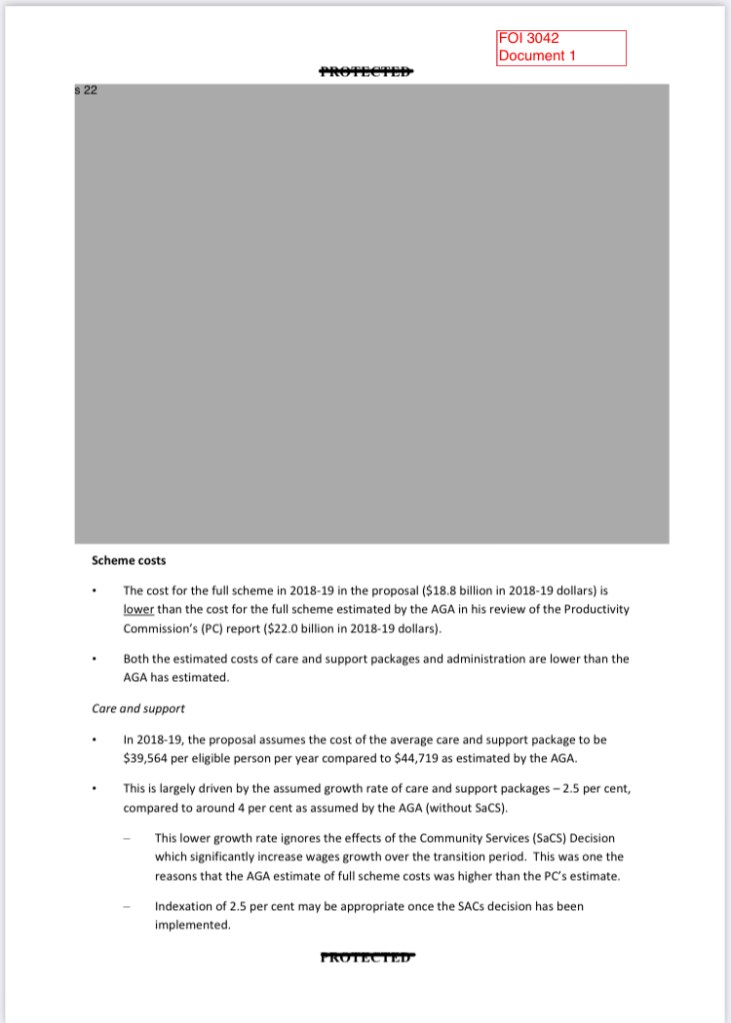
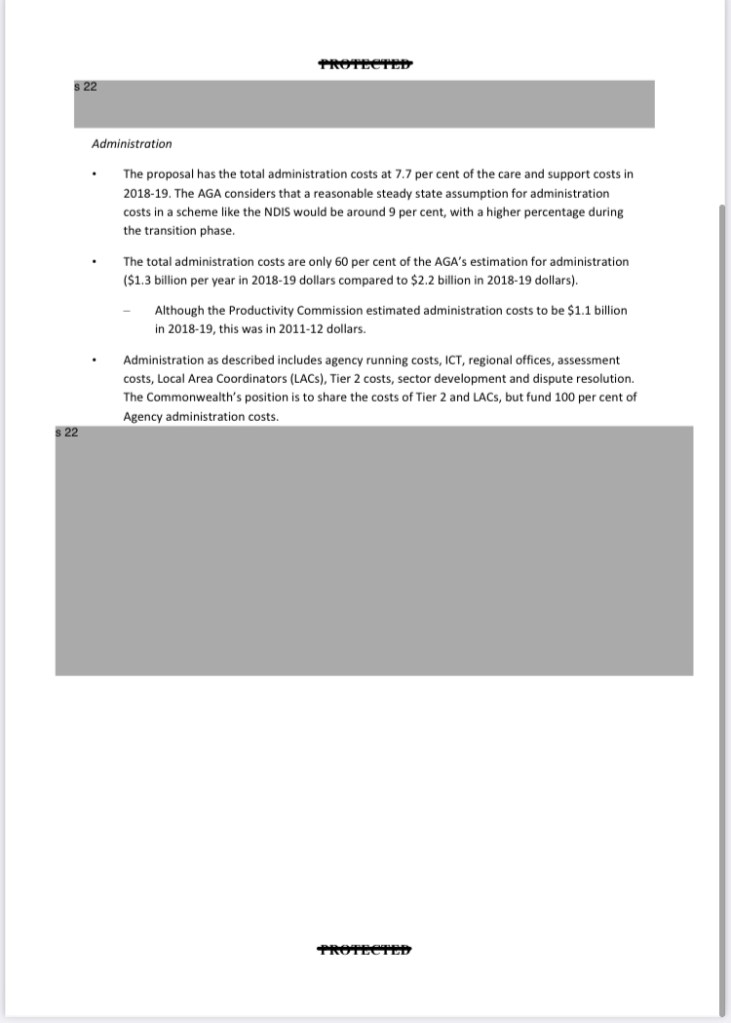
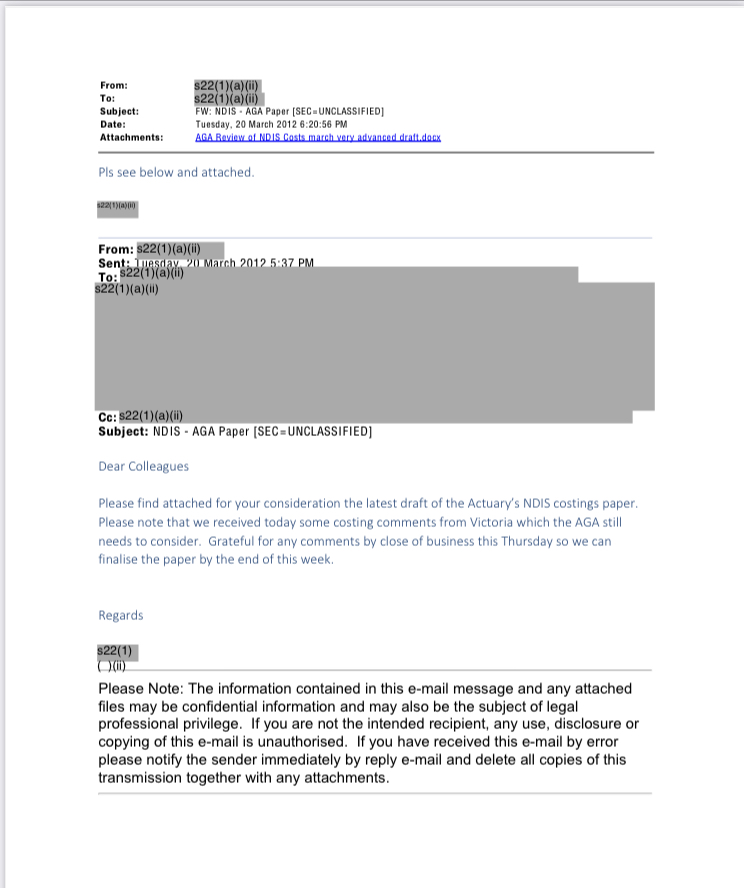
The Australian Government Actuary updated the NDIS costs after the Fair Work SCHADS decision because Andrew Baker (now of DSS) did an FOI and published the updated costs in his 2012 work The New Leviathan: A National Disability Insurance Scheme published by the Centre of Independent Studies. The updated costs were $22 billion per year at Full Scheme and are tracking well with reality.
Source: The New Leviathan: A National Disability Insurance Scheme
Nine News reported on the Centre For Independent Studies obtaining the Actuary’s 2012 updated cost estimate
Source: https://www.9news.com.au/national/disability-insurance-scheme-to-blow-out/d1c375d9-83e3-47bd-b8f6-e14d0acffc4d
However Labor presented the old 2011 cost estimate to Parliament, not the updated 2012 post-Fair Work SCHADS decision cost estimate.
Gillard introduced the NDIS Bill to Parliament on 29/11/2012. There was no debate as it was late in the year and Parliament went on holidays for Christmas. Debate didn’t start until February 2013, and lasted less than two months.
Mostly Labor avoided mentioning costs to Parliament at all, which I find astonishing for a $22 billion a year program. I was shocked reading Hansard that the politicians care so little about costs. No wonder our debt is almost $1 trillion now. I think we need to raise more funding with taxes or levies ASAP.
The vast majority of Gillard’s Cabinet chose not to speak in favour of the NDIS Act in the second debate.
All the speeches are on Hansard, and Prime Minister Julia Gillard spoke but didn’t mention costs, and Minister Jenny Macklin spoke but didn’t mention costs. And no other Cabinet Ministers spoke.
Source: APH Second Reading Speeches NDIS Act
The Cabinet are who would have been given the Actuary’s updated cost estimate by Treasury, as that is how Parliament works I think.
Treasury I guess gives the cost estimates to the Prime Minister and Cabinet. Cabinet have Cabinet confidentiality, but are meant to inform Parliament of relevant information.
Ed Husic was the only Labor MP who mentioned the cost estimate for the NDIS at full scheme. This happened on 7/2/2013. But he wrongly said the cost estimate was $15 billion.
Source: Hansard Ed Husic Speech
Ed Husic spoke to rebut Liberal MP Paul Fletcher’s claim that the NDIS would cost $22 billion a year, which Paul Fletcher got from The Centre For Independent Studies. I am not sure why Paul Fletcher didn’t go harder on the costs issue. Maybe because it was an election year.
Source: Hansard Paul Fletcher Speech
The Bills Digest from February 2013 by Luke Buckmaster also gives the incorrect costs, saying costs will be “nearly $14 billion”. I presume Luke Buckmaster got the information about the NDIS costs from Labor, since they were proposing the NDIS Bill.
Source: Bills Digest Feb 2013
The NDIS Act passed both Houses of Parliament on the 21st of March 2013.
It wasn’t until the May Budget 2013 that the Gillard Government admitted the costs of the NDIS had increased to around $22 billion per year. Presumably because Treasury don’t let politicians lie in the Budget.
Source: The Guardian
Also see The Budget 2013-14
Gillard did not admit that the main reason the costs of the NDIS had gone up from $13.6 billion to $22 billion was the Fair Work SCHADS decision.
Gillard was the architect of the Fair Work Act herself so she probably didn’t want to take responsibility for the Fair Work Act wrecking the financial sustainability of the NDIS, as Labor regularly prioritises workers and unions over disabled people.
(Edit 26/06/2022)
Gillard said she would increase the Medicare Levy to pay for the increased costs of the NDIS.
Tony Abbott supported the idea and Labor legislated for a 0.5% increase to the Medicare Levy to help fund the NDIS with bipartisan support.
Source: Sydney Morning Herald
In June 2013 Kevin Rudd won a leadership ballot and took over being leader and PM again.
Then in September 2013 Abbott led the Liberals to a win at the election.
Many Labor politicians from the Gillard Cabinet left politics at that point but some are still in politics including Anthony Albanese, Bill Shorten, Chris Bowen, Tanya Plibersek, Penny Wong, Mark Butler, Brendan O’Connor, Tony Burke and Mark Dreyfus.
The increase to the Medicare Levy came into affect in July 2014.
(End of Edit 26/06/2022)
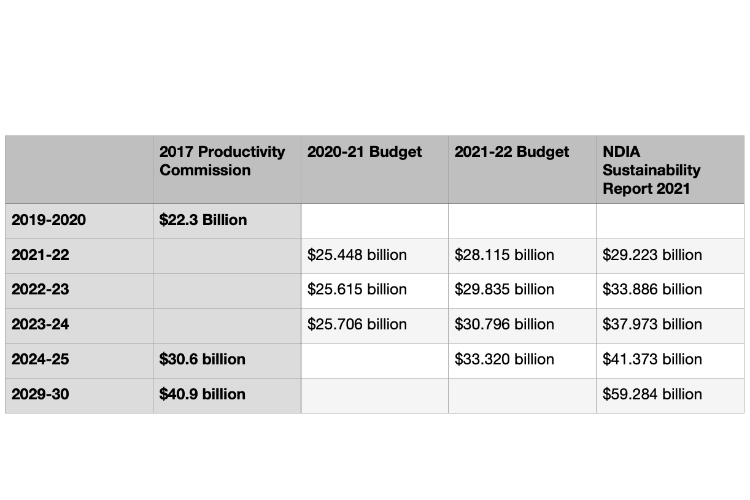
However it did not raise enough funds, and the funding gap persisted.
Existing disability spending at the time of the 2011 Productivity Commission Report was $7 billion, the 2011 $13.6 billion cost estimate was an increase of $6.6 billion, and the 2012 cost estimate of $22 billion was a further cost increase of $8.4 billion. That is a total cost increase to the Budget of $15 billion at full scheme.
In 2015-2016 the Medicare + NDIS levy raised about $15 billion, with 1/4 going to the NDIS, which is $3.75 billion.
$3.75 billion is less than 1/3 of the funding gap of $15 billion.
Centre Of Independent Studies, Fiscal Fiction: The Real Medicare Levy 2017
When Malcolm Turnbull took over as PM then Turnbull – backed by Treasurer Scott Morrison – tried to increase the Medicare Levy to provide more funding for the NDIS, by adding another 0.5% to the Medicare Levy.
But Bill Shorten, Leader of the Opposition, and Labor leader, refused to support it, saying it was a tax on ordinary workers.
It was around when Shorten refused to support Turnbull increasing the Medicare Levy for the NDIS, that the then CEO of the NDIS Rob de Luca started the program Operation Greenlight to restructure the NDIS and introduce Independent Assessments.
Rob de Luca is a disgraced banker from BankWest and LNP ex-Minister Christian Porter made de Luca CEO of the NDIS when de Luca quit or was fired from BankWest. de Luca has no disability or public service experience, and he brought in lots of BankWest people to work at the NDIS with him. He then quit in 2019 and moved to be CEO of Zenitas which has now won contracts (via subsidiaries) for the Independent Assessments de Luca helped design.
There’s a 2012 transcript on the APH website of Nationals Senator John Williams questioning de Luca and basically saying de Luca got BankWest staff to tell valuers to devalue properties which is corrupt. This was when BankWest caused a crisis in the GFC by how they managed their loans.
So the NDIS has a massive funding gap in terms of government costs largely because of the Fair Work SCHADS decision, and Labor gave Parliament the wrong cost estimates.
I think Labor has to have deliberately misled Parliament about it, because it is impossible so many law school graduates are that incompetent to accidentally get the costs wrong by billions of dollars. They all had staff working for them too. And they had been in Government since 2007
Some people I have told say it was a mistake. But if it was a mistake it was grossly incompetent.
This affects over 400,000 vulnerable Australians who have now been transferred from local and State programs to the NDIS, which was enacted by a Parliament not aware of the cost implications of the Fair Work SCHADS decision on the NDIS.
Misleading Parliament is wrong because the Parliament makes the laws we all have to live under, and needs the full information to do so. Plus misleading Parliament compromises the politicians who do so, making them susceptible to blackmail by foreign powers according to the case of the Profumo Affair
This is why I have reported them to the Committee of Members Interests and Privileges.
Edited 4th May 2022
Edited 26/06/2022

 Zoe Emily Mithen