I’m on the NDIS. Here’s what Labor must do to fix it

Article published in the Australian Financial Review

The National Disability Insurance Scheme’s future hinges on the Albanese government’s willingness to listen, reform equitably, and invest in all disabled Australians.

Labor’s resounding election victory has been celebrated by National Disability Insurance Scheme participants and their families. Yet many of us also feel uncertain about the scheme’s future.

The election of two disabled parliamentarians – Senator Jordon Steele-John and new lower house member Ali France – marks a historic milestone, as does the creation of a disability minister. On social media, the disability community this week met the appointment of the new NDIS ministers, Mark Butler and Jenny McAllister, with cautious optimism that their focus will extend beyond cost-cutting.

an NDIS participant, I urge the Albanese government to prioritise relationships, equity, and broader disability reforms to secure the scheme’s long-term success.

First, the government must rebuild its fractured relationship with NDIS participants. Over the past term, reforms and legislation have taken precedence over engagement, with public messaging often blaming participants for the scheme’s rising costs. This narrative – shaped by political strategies from RedBridge to justify reforms and cost-cutting – has fuelled stigma.

Online, many of us face hostility from non-disabled Australians who question our disabilities or label us “rorters”. This undermines the NDIS’ goal of fostering inclusion. The government must counter this by depicting participants more positively as valued citizens, not expenses, to restore trust and combat social exclusion.

Second, the planned five-year reform of the NDIS’ planning and budgeting processes must prioritise equity. Equity means ensuring the most profoundly disabled receive adequate support, regardless of cost.

The new needs assessments must be fair, consistent, and designed in a way that utilises participant feedback. Media suggestions to exclude “higher-functioning” participants from the NDIS to cut costs simply do not add up. National Disability Insurance Agency data shows that the 215,694 participants classified as levels 1 to 5 (higher functioning) account for just $4 billion of the scheme’s nearly $50 billion annual cost. Excluding this group would save very little.

For me, as someone likely classified as low functioning – we are not told how we are classified – the NDIS improves my quality of life. Without it, I wouldn’t die, but my mental health would deteriorate, my isolation would increase, and my ability to engage in and contribute to society would diminish.

The NDIS enables therapy to improve my functioning and supports my participation in everyday activities, giving me a quality of life closer to that of non-disabled Australians. For others, the NDIS is a matter of life and death, providing essential support to stay healthy. Reforms must recognise the NDIS’ dual purpose: ensuring health and survival for some and enhancing quality of life for all.

Third, the NDIS cannot exist in isolation. To justify its significant budget share, the government must ensure all disabled Australians enjoy a decent quality of life.

A critical reform is raising JobSeeker payments above the poverty line, at an estimated cost of $10 billion annually. Nearly half of JobSeeker recipients have disabilities or chronic illnesses but don’t qualify for the disability support pension. With employers often discriminating against disabled jobseekers, and 20 per cent of Australia’s suicides linked to JobSeeker recipients, this reform is urgent. Prime Minister Anthony Albanese, who has spoken of the challenges of growing up with a disabled mother on welfare, is well-placed to champion this change.

Fourth, the NDIA needs an organisational overhaul. Participants often encounter staff lacking deep knowledge of disabilities or the NDIS system.

High staff turnover and a poor work environment, as reported in online workplace reviews, depletes expertise. Investing in training and retention, with transparent reporting on these metrics, is essential. Better data collection is equally critical. Current IT systems limit the NDIA’s ability to measure outcomes or demonstrate the scheme’s benefits, leaving media narratives fixated on costs. Robust data could shift the conversation towards the NDIS’ social and economic value.

Finally, the government must begin to address human rights concerns, including sub-minimum wages in Australian disability enterprises, forced group living for high-needs participants, and educational segregation of disabled youth.

Progress on these issues, aligned with the UN Convention on the Rights of Persons with Disabilities, would signal a commitment to inclusion and equity.

The NDIS is a landmark achievement that was enacted by a Labor administration, but its future hinges on this government’s willingness to listen, reform equitably, and invest in all disabled Australians. Prime Minister Albanese has a chance to make this a defining legacy. The disability community is counting on him to ensure no one is left behind.
Thoughts On The NDIS Review

The Albanese Labor Government commissioned a Review of the NDIS, after winning the 2022 Federal Election. The Review was headed by Bruce Bonyhady, commonly known as the grandfather of the NDIS because he was responsible for the NDIS being proposed at the 2008 “2020 Summit”. The Review was made public in December 2023.

I have concerns about the NDIS Review, mainly around the Review wanting so much government intervention in the NDIS Market. Rodd Simms of the ACCC spoke in 2018, saying: 

“Do you intervene to prevent market failure, or to correct it once it has already begun? If you do intervene, do you do so with a light-touch, or a heavy-touch?”

I feel like the Review is asking for changes that have a “heavy touch”.  

The Review says that the NDIS Market is not working well, and that this justifies them recommending what I see as heavy intervention by the government and the NDIA. At the same time the Review says it is impossible to know where the thin markets are, and what the problems are. So this seems to be a contradictory approach. If the Review can’t get enough information about the problems with the NDIS Market, then how can it know it is accurately identifying the right problems and coming up with solutions for them?  

The main things I am concerned about are the Review’s emphasis on what they refer to as “market visibility”; the proposals about the collection of information and data about participants; and some details about the design of a new “unified disability ecosystem”. 

The Review proposes to make all providers Registered so that the market is visible to the NDIA and to participants and Navigators. Being visible means that every provider in Australia will be listed in a database. I have several unregistered sole trader providers now, and I would hate to lose them because the registration process is not worth their time and effort. I also do not think some of my providers would want to be on a provider database for Navigators and participants to use, as some of them only have me as an NDIS client, and do other jobs most of their time.

I don’t think it is a good idea to eliminate Support Coordinators and Recovery Coaches and replace them with Navigators who work in an organisation that wins a tender from the NDIA. Local Area Coordinators — currently done by organisations with tenders from the NDIA — will be eliminated and their role in doing planning will be transferred to the NDIA. I am not against planning being done by the NDIA but it will make a big change. I do not think that Navigators will be better than Support Coordinators and Recovery Coaches, I would rather keep these supports in the free market, rather than have the service done by organisations who win a tender by the NDIA, and where the workers are similar to bureaucrats.

Similarly there is a proposal to make all payments electronic, again so that the market is visible, with all payments being on an NDIA database. I am not actually against this, and I think it might make things easier for me as a participant. But I think we need to think about and discuss the issue of digital surveillance of NDIS participants.

As we have seen in the section on market visibility the Review speaks a lot about increasing the collection of data and information. Another example of this are  the functional assessments that will be used in the proposed NDIA Planning process. During the controversy over the Independent Assessments we learned that there is no comprehensive assessment tool to use on all disabilities, and that it is very difficult to compare the results of various functinal assessment tools to get fairly ranked functioning and funding results. I would like to see the development of NDIS specific functional assessment tools by Australian Universities. I do not believe the NDIA has the capacity to develop a holistic set of functional assessment tools. These assessments will create a lot of information about us, which will be kept in NDIA databases. 

The Review also talks about measuring the outcomes we have with our NDIS plans, which would also require the collection of data on us, and the storage of the data by the NDIA. The data on outcomes could lead to higher payments for the providers who are seen to produce better outcomes, but there is no information on how this would be measured and compared. This concept of rewarding better outcomes is central to the Review’s goal to improve the quality of providers. 

So the NDIS would have data on every Australian NDIA provider, they would have data about us from our functional assessments, they would have data about the outcomes we have from using our NDIS funding, they would have data on every transaction we make to use our NDIS funding. That is a lot of data to have on every individual in the NDIS. I cannot think of another government body that would collect and store that much information on its service users.  This raises questions for me — How much data do we want collected on us? Will we have any control over this? What if our information was hacked? How can disabled people and DPOs be involved in data collection similar to how Closing The Gap involves indigenous people and their organisations in data collection and dissemination. I believe strongly that we need to have a discussion about the NDIS and data collection. We do not want NDIS participants to become the most suveilled people in Australia. 

There are three main issues that concern me about the design of the new system. First the shift to create two separate levels in the disability support system — NDIS and Foundational Supports — without it being clear where the boundary is between the two levels. Will the NDIS have the same eligibility criteria as it does today? Or will the eligibility criteria be changed and some people shifted off the NDIS into Foundational Supports? To do a cost benefit someone would need need to look at both costs of the NDIS and costs of the proposed Foundational Supports. We do not even know how many people are expected to use the Foundational Supports at the moment, let alone the cost.

Second, the proposal for a separate Psychosocial Pathway makes me very anxious. It will mean that people with Psychosocial Disability, like me, are treated differently from other people in the NDIS, and signals — by saying that they should remain on the Early Intervention pathway for 3 years — that people with Psychosocial Disability are not seen as having the same level of disability or permanence of disability as other participants in the NDIS. How do we know that an Early Intervention approach for Psychosocial Disability won’t actually increase the number of Psychosocial participants by having a lower eligibility threshold? I am concerned about the focus on Personal Recovery and capacity building supports, as the Review appears to think that Personal Recovery (which means living our best life as a person with mental illness) would mean we need fewer supports. In my opinion it is Clinical Recovery not Personal Recovery that could mean someone needs fewer supports, and in fact in order to maintain Personal Recovery we may need more supports to live our best life despite the symptoms and impairments that go with lifelong mental illness. 

Third, the Review does not go into a lot of detail of the design of the new disability ecosystem, and I am worried that there is a lack of details for some of the proposals, and also worried that without a proper cost benefit analysis of the new system being made public, we can’t even know if these proposals are going to help with the financial sustainability of the NDIS which was the main reason for the Review. Are we just going to be back here in another 5 years, with the media saying it’s NDIS participants’ fault that the NDIS is costing too much? I really hope not.

Swords Into Ploughshares

I haven’t posted for a while here. My mental health has not. been great. Some personal issues but also the state of the world, especially with two big wars happening now between Russia and Ukraine and also Israel and Palestine. I am not totally anti-war, as my grandfather was a soldier in WW2, but I can’t see either of these wars as having a just reason. They are both about territory essentially, and strangely they are both about territory that was formerly in the Ottoman Empire. Crimea was held for a long time by the Ottoman Empire, and the Ottoman Empire helped other nations fight Russia for in the Crimean War, and Palestine was part of the Ottoman Empire. It is very depressing that former territory of the Ottoman Empire is again violently contested. In Australia we remember the WW1 Gallipoli Campaign fought in the Ottoman Empire (now modern day Turkey).

I remember at University some of the history subjects I took covered the early stages of the Israel-Palestine conflict, starting with the carving up of the Ottoman Empire after WW1. The Allies wanted to make sure there wasn’t a powerful State in the Middle East so they carved it up, and the boundaries they created often exacerbated ethnic tensions. The rise of Zionism in the late 19th C led to European Jewish people moving to the territory we now call Israel and Palestine. Zionism is an ethnic nationalist ideology where some Jewish people feel connected to Israel as an ancestral homeland and want to start a nation there. Ethnic nationalist beliefs were really popular in the West in the late 19th C and first half of the 20thC.

I am not sure where someone should identify a homeland for the Jewish people, but in Genesis it states that Abraham was born in Ur of the Chaldees, which is located in modern day Iraq. Perhaps we could talk about multiple homelands for a people on the move.

After WW2 ended and the Holocaust became public knowledge, the Allies decided to support the creation of a Jewish State, Israel, in Palestine. At the time it was thought Jewish people were unsafe in Europe because they didn’t have a homeland and there had been centuries of antisemitism, culminating in the Holocaust. However the land was not empty. Palestinian people lived on the land that became the first territory of the new State of Israel. Palestinians call the violent displacement in 1948 the Nakba, which means the catastrophe. Over the next 70 years, the State of Israel expanded its territory by displacing more Palestinians. The land occupied by Palestine now is fragmented and crowded. Palestine is recognised as a State by the United Nations, but many places like the USA and Australia do not recognise Palestine as a State. Many people in Gaza are very poor and unemployed. It is a dangerous place to live.

I don’t really have any great ideas about how these two conflicts should be resolved, but I do hope they are resolved soon, and that the pointless loss of lives stops. It is a difficult situation where conflict and violence has been entrenched for around 70 years and negotiations have proved very hard work. May peace come.

(Revised from a Facebook post)

Labor Government Policy To Exceed 1.5C “Temporarily”

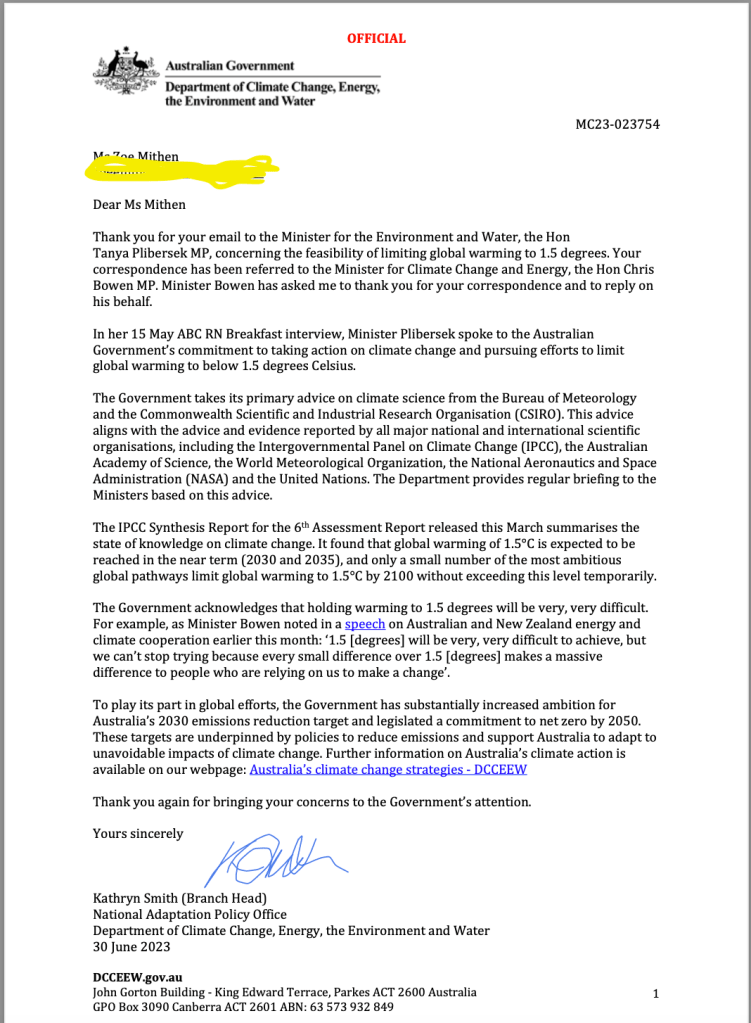
I was disappointed today with a reply I got from writing to Minister Tanya Plibersek about climate change. The reply seems to indicate that the Labor government has a policy of exceeding 1.5C “temporarily” and then returning to 1.5C later, presumably via carbon capture and storage technology. I do know that it is more and more difficult to limit global warming to 1.5C as time goes on, but I would like to see Australia move towards a Climate Mobilisation to reduce emissions rapidly.

Speech at School Strike For Climate, 3rd of March 2023, Victory Park, Castlemaine

Thank you to the school strikers for having me speak today. I’m Zoe and I am disabled. I have Autism and Schizoaffective Disorder, and I want to talk a bit today about disability and climate change.

1 in 6 Australians, or 4.4 million people, are disabled. That is a sizable number, and many of you will be disabled yourself, or have friends or family who are disabled. 

Climate Justice means addressing the needs of those people most affected by climate change, and implementing solutions that are fair and equitable. This includes the young and future generations, who have organised this protest today, older generations, Indigenous people, and disabled people.  

People with disability are not often considered in Australian climate policy discussions even though we are disproportinately affected by climate change and emergencies and extreme weather events. 

People with disability are affected more because of our disabilities, inaccessible design, and also because many of us live in poverty compared to non-disabled people. 

In the Paris Agreement (2015) only 37 out of 192 States Parties included disability, which shows how overlooked we are. People with disability and Disabled People’s Organisations need to be included in policy making at an international level, as well as at National, State, and local levels.  

Some examples of how disability interacts with climate change include: some disabilities negatively affect the ability to regulate body temperature which can lead to overheating at high temperatures; the many disabled people living in poverty find that poverty reduces access to food at times of drought, crop failures, and food shortages; during emergencies people with disabilities may lose Assistive Technology and be unable to access visual or audio news and warnings or move to escape from risk; respiratory conditions are worsened by climate change lengthening the pollen season and increasing its intensity as well as increasing the frequency of thunderstorms;  people with Schizophrenia have up to 50% higher chance of dying in heatwaves than non-disabled people; and people with disability suffer high rates of violence, including police violence, and unfortunately climate change will increase social stress which is linked to increased violence. 

There are only around 6 to 9 years left before we have used up the global Greenhouse Gas Budget for a 50% chance of limiting global warming to 1.5C, so we need to act rapidly to reduce our Greenhouse Gas Emissions, and stay hopeful because even if we overshoot 1.5C we can aim for other targets like 1.7C. We must keep working together to limit climate change and to protect the most vulnerable.

Labor’s 43% Climate Reduction Target and the GHG Budget

The new Labor Government led by Prime Minister Anthony Albanese has a goal for a 43% reduction in Greenhouse Gas Emissions compared to 2005 levels, by 2030.

Is this goal adequate and does it fit within Australia’s emissions budget?

According to my analysis the answer is no.

Malte Meinshausen from the University of Melbourne did a Greenhouse Gas Emissions Budget analysis for the Victorian Government in 2019, looking at the Global GHG Emissions Budget, The Australian national GHG Emissions Budget, and the Victorian State GHG Emissions Budget to give us a 50% chance to of limiting Global Warming to 1.5C, in line with the Paris Agreement.

According to this analysis the Global GHG Emissions Budget from 2013 to 2050 when we reach Net Zero is only 800 Gt CO2eq. From 2013 to 2022 the world emitted about 435 Gt CO2eq, which leaves us with a budget of only 365 Gt CO2eq from 2022 to 2050.

From 2013 to 2022 annual global GHG emissions rose rather than decreased. Global emissions are now around 50 Gt CO2eq per year. So 365 Gt CO2eq will be used up in just over 7 years unless global emissions begin to drop substantially in the next year or two.

In terms of Australia, Malte Meinshausen calculated we have a 5.5 Gt CO2eq Budget from 2017 to 2050 when we reach net zero.

This figure was arrived at using The Australian Climate Change Authority’s concept of what a fair share of the global emissions budget would be for Australia. They are quite generous to Australia. Using other ethical approaches more favourable to developing countries would result in a reduced emissions budget for Australia.

From 2017 to 2022 Australia emitted 2.64 Gt CO2eq, which leaves only 2.86 Gt CO2eq in our National emissions Budget from now until 2050.

Our emissions are roughly 0.5 Gt CO2eq per year.

At this rate we will use our Budget for the next 28 years all up within only 6 years.

Labor’s 43% emissions reduction goal is clearly not good enough.

It will not keep Australia within our fair Greenhouse Gas Emissions Budget.

And therefore, unless the rest of the world does the heavy lifting in lieu of Australia, we will not succeed in meeting our goal of limiting Global Warming to less than 1.5C.

We need Labor to draw up a much better climate policy. This decade is crucial to humanity’s future.

NDIS Premiums

If the NDIS is an insurance scheme then at about $30 billion per year now and covering a population of about 26 million the premium would be $1,111 per person per year.


In 2030 the NDIS is forecast to cost $64 billion per year and the Australian population is projected to be 30 million, so the premium would be $2,133 per person per year.


If we compare this to Health, the cost of Health in Australia is $200 billion which is $7,400 per person per year.


Education is roughly $3,700 per person per year.

Labor and the Carbon Pollution Reduction Scheme (CPRS) 2009

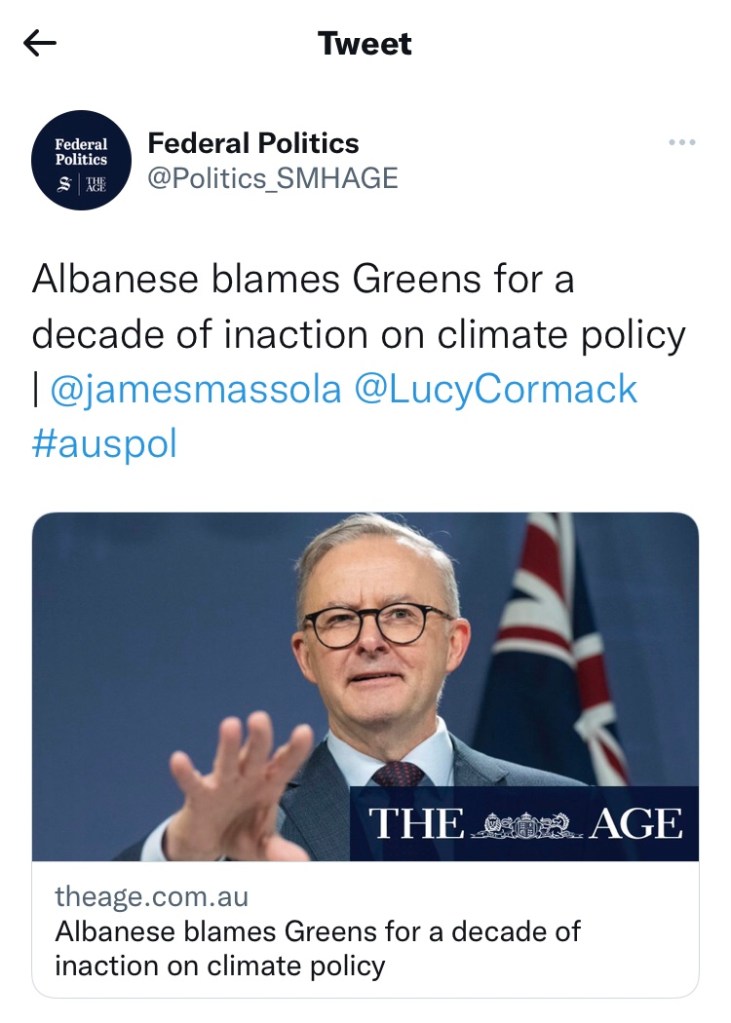
The media is quoting Labor Prime Minister Anthony Albanese saying he has a “mandate” for Labor’s inadequate 2030 emissions reduction target, and Albanese is bringing up the stoush with The Greens over the CPRS in 2009.

From The Age: “‘We have a mandate for our position on climate. We announced it in December last year, we announced 43 per cent by 2030. We announced 82 per cent renewables as part of the national energy market by 2030. It will create 604,000 new jobs,” he said.

“It will result in Australia rejoining the world effort to tackle climate change. If the Greens party haven’t learned from what they did in 2009 – that was something that led to a decade of inaction and delay and denial – then that will be a matter for them.”’

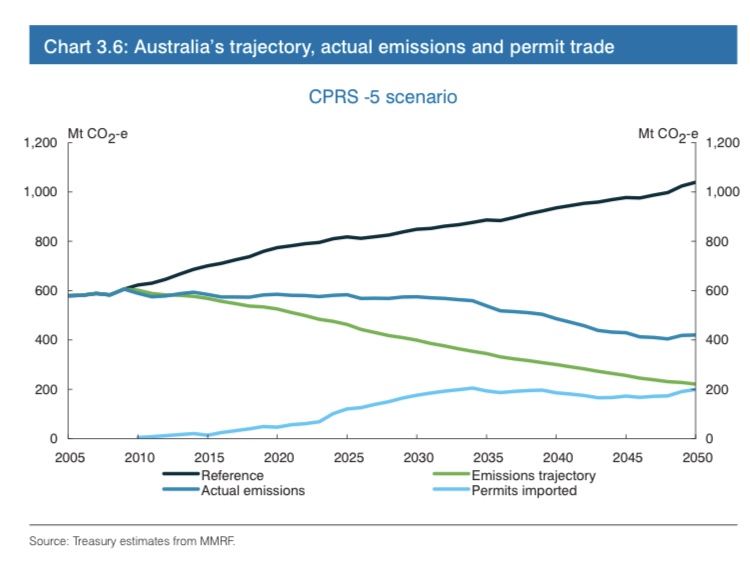
A little while ago someone on Twitter told me the CPRS would not have resulted in any real emissions reductions until after 2030, because in the Treasury modelling the emissions reductions were mostly from imported permits, i.e. Australia would buy carbon offsets from overseas rather than reduce our own emissions.

This was the graph that the person showed me:

I am a big supporter of Kevin Rudd’s Government, but this graph does certainly seem to show that the CPRS would not have made much difference up until 2030.

Labor’s current policy of a 43% reduction in emissions (from 2005 levels) by 2030 is also very inadequate, and won’t achieve much.

It includes 19% of emissions reductions already achieved (and celebrated by the Liberals and Nationals) through land-use and deforestation changes.

That leaves only 24% of emissions reductions for Labor to achieve between now and 2030.

Even if these reductions were entirely from the energy sector, that would mean in the 25 years since 2005 Australia has only cut energy sector emissions by 24%.

That is not doing our fair share under the international agreements which are meant to keep global warming to under 1.5C.

NAIDOC Week

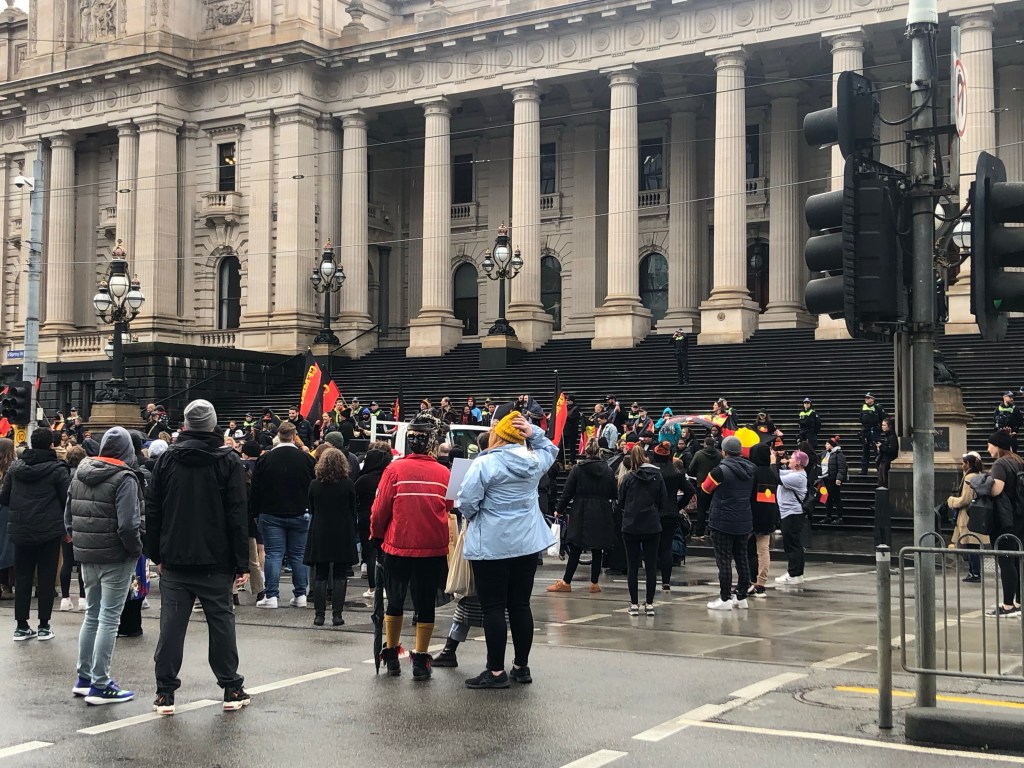
NAIDOC protest today 8/7/2022 outside Parliament House

For NAIDOC week I want to write something about what happens when we look away from injustice.

Today I’m in Naarm, the land of the Bunurong Boon Wurrung people and the Wurundjeri Woi Wurrung people of the Eastern Kulin Nation. I live in Jaara country the land of Dja Dja Wurrung people of the Kulin Nation.

My maternal grandfather’s family lived in Warragul in Gippsland, they had Scottish ancestry. Before I was born my Mum bought a miners cottage in Maldon, a small gold rush town, and before we moved there when I was 1 year old, she rented it out to Don Watson who would later become Prime Minister Paul Keating’s speech writer and who authored the famous 1993 Redfern speech, the focus of a historiographical dispute in Australia over who should be credited with speeches – the speech writers, or the politicians who speak the words in public?

1993 was the International Year of the World’s Indigenous People.

The Redfern speech says that year came at a time “when we have committed ourselves to succeeding in the test which so far we have always failed. Because, in truth, we cannot confidently say that we have succeeded if we have not managed to extend opportunity and care, dignity and hope to the Indigenous people of Australia.”

It goes on to say that at Redfern “a mile or two from the place where the first European settlers landed, in too many ways it tells us that their failure to bring much more than devastation and demoralisation to Aboriginal Australia continues to be our failure.”

“We simply cannot sweep injustice aside. Even if our own conscience allowed us to, I am sure, that in due course, the world, and the people of our region would not.”

I started to take up a hobby of reading old laws a while ago, looking for laws that could be relevant to climate change. While I was reading about old laws, one thing struck me as a huge injustice for Indigenous Australians.

Britain had two legal ways of colonising territory. When I say legal I mean legal according to their own laws.

Under British law territory could be colonised under the law of Settling if the territory had no existing inhabitants.

If the territory did have inhabitants then, under British law, Britain could only colonise the territory under the law of Conquering.

Did it make any difference whether a territory was settled or conquered?

Yes in fact it did, very much so.

A Settled Colony could establish Statutory Law and also English Common Law over the territory.

A Conquered Colony on the other hand was only allowed to establish Statutory Law, and was not allowed to establish Common Law.

The reason for this being that Common Law was the traditional law of the English people.

In a Conquered Colony there already was a people who had their own traditional law.

Thus, in a Conquered Colony the existing inhabitants were entitled to retain Native Law, and Native Law would remain in place in the Colony instead of English Common Law.

Instead of following their own law of colonisation, Britain colonised Australia and pretended it had no inhabitants (Terra Nulius) and that therefore it could be legally Settled. And the colonists established English Common Law here, and never recognised the legal right of Native Law.

Now I am a disabled person with a bit of spare time who took one Masters level subject in urban planning law.

If I can find out this information about British laws for colonisation, it strikes me that hundreds of actual lawyers in Australia and the UK must have found out this information first, and just looked away.

There is even an article about the topic on the Australian Government website for the Australian Law Reform Commission, from 18/08/2010, called “The Settled Colony Debate”.

This refers to Blackstone in 1765 distinguishing between cultivated and uncultivated land, and says territory that was “uncultivated” could be settled.

We know in Dja Dja Wurrung country that the women did actually cultivate the land, they made it abundant in murnong the bright yellow flowering yam daisy.

Do we merely fail at giving equality and a better quality of life to Indigenous people?

Or do we deliberately not want the bother and the financial and legal costs of truly reckoning with the injustices of our Nation’s past?

I’m not sure.