
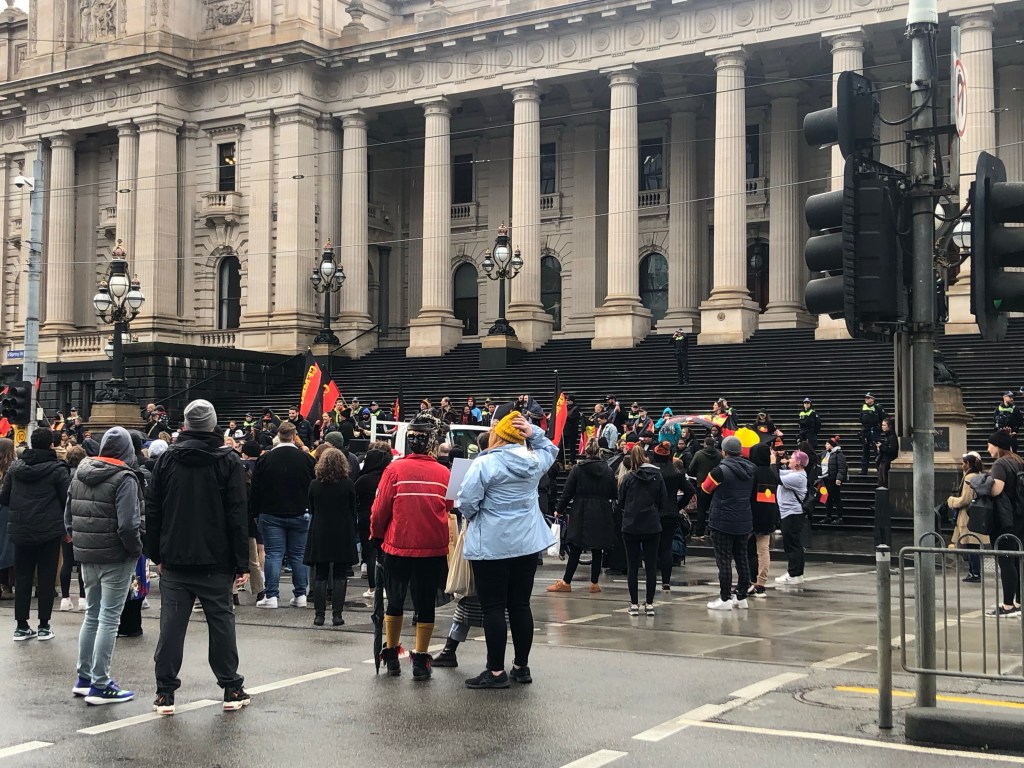
For NAIDOC week I want to write something about what happens when we look away from injustice.
Today I’m in Naarm, the land of the Bunurong Boon Wurrung people and the Wurundjeri Woi Wurrung people of the Eastern Kulin Nation. I live in Jaara country the land of Dja Dja Wurrung people of the Kulin Nation.
My maternal grandfather’s family lived in Warragul in Gippsland, they had Scottish ancestry. Before I was born my Mum bought a miners cottage in Maldon, a small gold rush town, and before we moved there when I was 1 year old, she rented it out to Don Watson who would later become Prime Minister Paul Keating’s speech writer and who authored the famous 1993 Redfern speech, the focus of a historiographical dispute in Australia over who should be credited with speeches – the speech writers, or the politicians who speak the words in public?
1993 was the International Year of the World’s Indigenous People.
The Redfern speech says that year came at a time “when we have committed ourselves to succeeding in the test which so far we have always failed. Because, in truth, we cannot confidently say that we have succeeded if we have not managed to extend opportunity and care, dignity and hope to the Indigenous people of Australia.”
It goes on to say that at Redfern “a mile or two from the place where the first European settlers landed, in too many ways it tells us that their failure to bring much more than devastation and demoralisation to Aboriginal Australia continues to be our failure.”
“We simply cannot sweep injustice aside. Even if our own conscience allowed us to, I am sure, that in due course, the world, and the people of our region would not.”
I started to take up a hobby of reading old laws a while ago, looking for laws that could be relevant to climate change. While I was reading about old laws, one thing struck me as a huge injustice for Indigenous Australians.
Britain had two legal ways of colonising territory. When I say legal I mean legal according to their own laws.
Under British law territory could be colonised under the law of Settling if the territory had no existing inhabitants.
If the territory did have inhabitants then, under British law, Britain could only colonise the territory under the law of Conquering.
Did it make any difference whether a territory was settled or conquered?
Yes in fact it did, very much so.
A Settled Colony could establish Statutory Law and also English Common Law over the territory.
A Conquered Colony on the other hand was only allowed to establish Statutory Law, and was not allowed to establish Common Law.
The reason for this being that Common Law was the traditional law of the English people.
In a Conquered Colony there already was a people who had their own traditional law.
Thus, in a Conquered Colony the existing inhabitants were entitled to retain Native Law, and Native Law would remain in place in the Colony instead of English Common Law.
Instead of following their own law of colonisation, Britain colonised Australia and pretended it had no inhabitants (Terra Nulius) and that therefore it could be legally Settled. And the colonists established English Common Law here, and never recognised the legal right of Native Law.
Now I am a disabled person with a bit of spare time who took one Masters level subject in urban planning law.
If I can find out this information about British laws for colonisation, it strikes me that hundreds of actual lawyers in Australia and the UK must have found out this information first, and just looked away.
There is even an article about the topic on the Australian Government website for the Australian Law Reform Commission, from 18/08/2010, called “The Settled Colony Debate”.
This refers to Blackstone in 1765 distinguishing between cultivated and uncultivated land, and says territory that was “uncultivated” could be settled.
We know in Dja Dja Wurrung country that the women did actually cultivate the land, they made it abundant in murnong the bright yellow flowering yam daisy.
Do we merely fail at giving equality and a better quality of life to Indigenous people?
Or do we deliberately not want the bother and the financial and legal costs of truly reckoning with the injustices of our Nation’s past?
I’m not sure.
 Zoe Emily Mithen